Twelve Hours of a Harbour, Already in the Page
Plays twelve hours of recorded Potomac AIS from the desktop capture. The live tool listens; this is the playback file.
AIS Watch answers a different question from a live plot. A live plot tells you who is there now. A twelve-hour recording tells you who met whom, who waited, and who left before you looked.
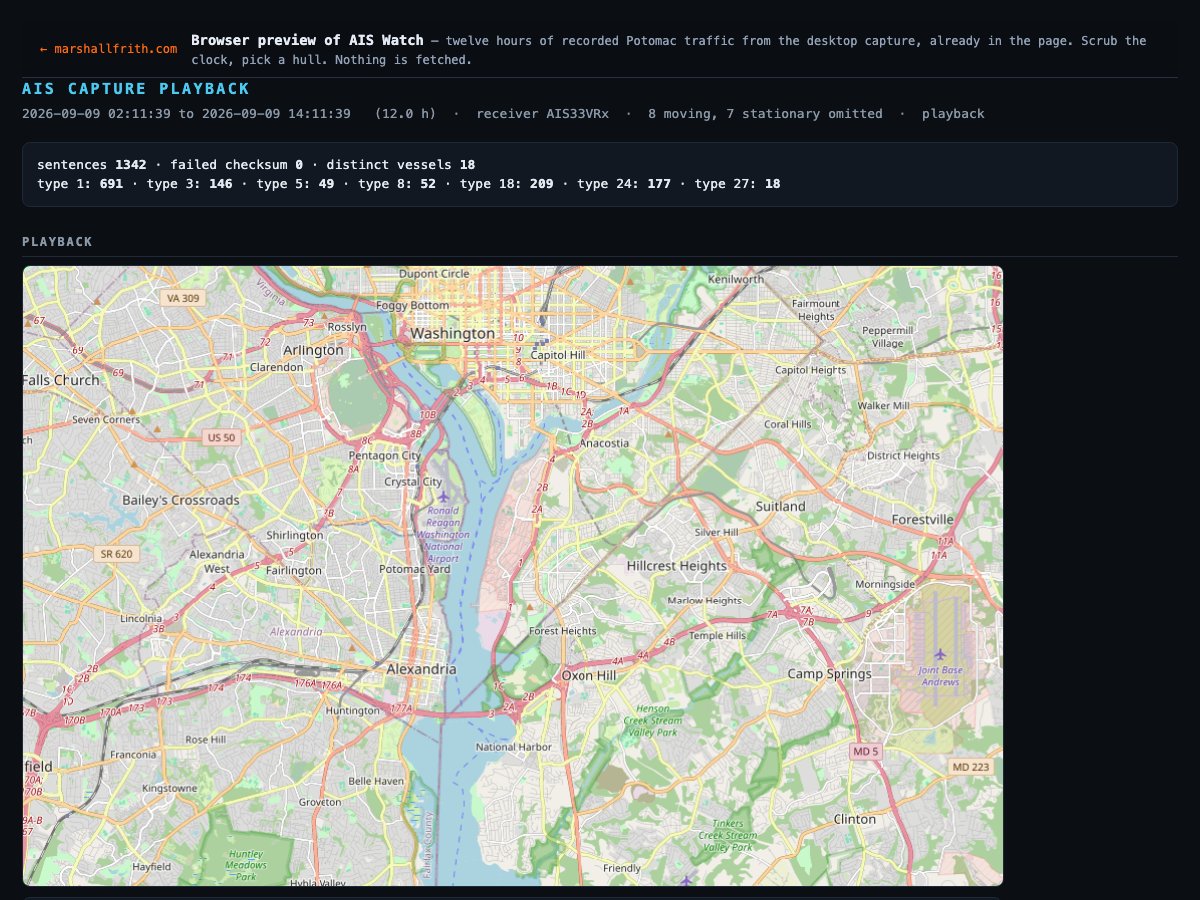
Try the browser preview. No install, no feed, no account. Twelve hours of Potomac traffic from the desktop capture is already in the page. Scrub the clock, pick a hull, watch the wake. Nothing is fetched. The desktop tool listens to a receiver you already run and can hand the same picture to ATAK.
Why twelve hours
A harbour is a tide and a shift change. Twelve hours is long enough to see both. Short enough to ship as one file.
Who was in the channel at 03:00. Whether the tanker ever weighed. Whether the ferry and the inbound missed each other by minutes or by a mile. A plot that only works while you watch cannot answer that.
How the demo works
This page is a recorded export, not a live harbour. The tracks are already in the HTML. Your browser plays them. Nothing is fetched. No tile server. No aggregator. No socket back to a receiver.
Hull names and tracks come from the Potomac capture. The basemap is OSM tiles baked into the page with the tracks. Treat it as a real recorded window, not a live harbour and not a Hampton Roads sketch.
Fresher copies replace this file the same way it was made. Capture a window. Export HTML. Put the page on the site. The public site never talks to the receiver.
Receiver, capture, export, page
That is the whole model.
- A USB AIS receiver hears the broadcasts.
- Capture writes the traffic.
- Export bakes twelve hours into a self-contained HTML playback.
- The site serves that file.
The desktop tool does the other half on a machine you control: decode, filter, and push Cursor-on-Target onto a TAK network. That half stays off the public page on purpose. A live aggregator would need a key and would log every visitor's interest in a stretch of water.
Gear
The box on the bench is an AIS Receiver Portable AIS Receiver with Stable USB Output for Marine. USB NMEA out. Plug it in. It talks. Coverage is whatever the antenna can hear. The story is the twelve-hour file, not the box.
What the preview leaves out
Real MMSI lookups, a live feed, ATAK export, and any chart tiles. If you need yesterday's real picture, that is the desktop tool and a feed you already have a licence for.
ADSB-TAK is the airborne twin of the same idea. Ship Finder is what the water looks like when the AIS is off.

Comments