Soil sampling for pecan orchards — and why pecan truffles matter
Desktop NDVI Scope turns a multi-year May–September canopy stack into soil-sample pins for a pecan orchard. The pins are bags for the lab, not a pH map and not a truffle map.
The desktop copy of NDVI Scope stacks several May–September seasons of Sentinel-2 over a pecan orchard and drops soil-sample pins where the canopy is unlike the rest. Steadier green versus patchier green, so the soil cores represent real differences instead of one lucky (or unlucky) bag. Those pins are places to dig for the lab. They are not a pH map, and they are not a truffle map. This is the desktop tool, not the public /ndvi/ map.
Those pins are places to dig for the lab — not a pH map and not a truffle map.
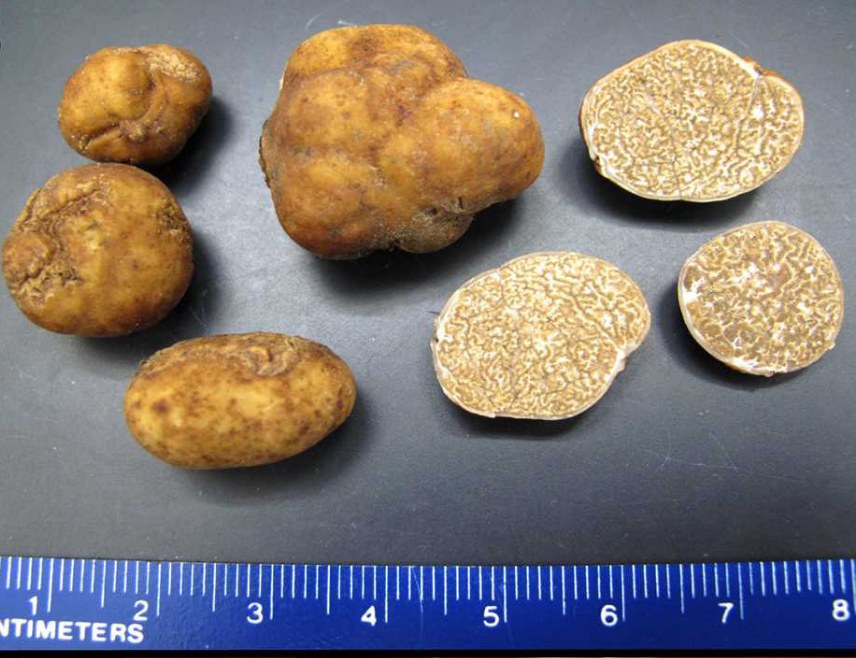
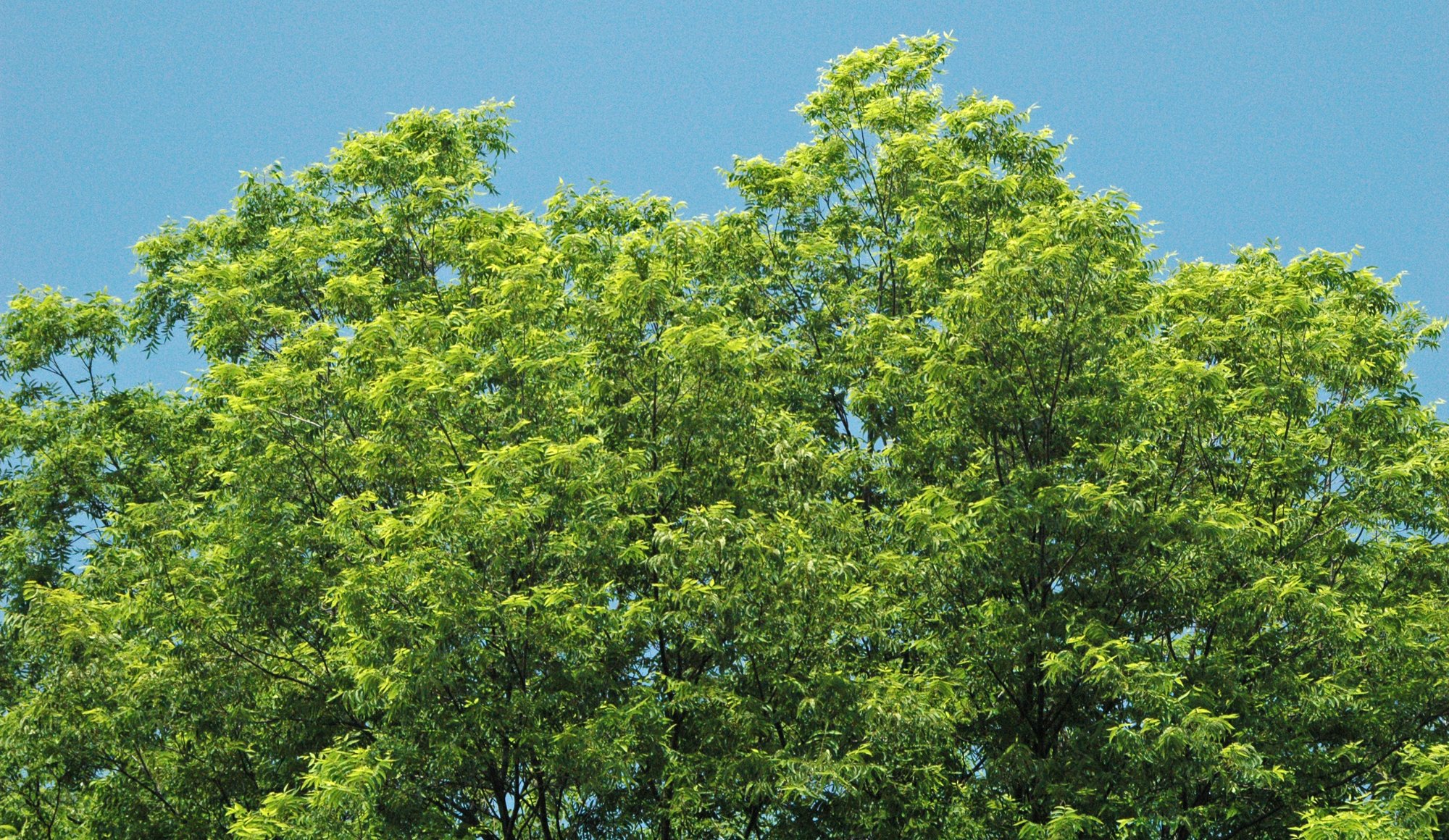
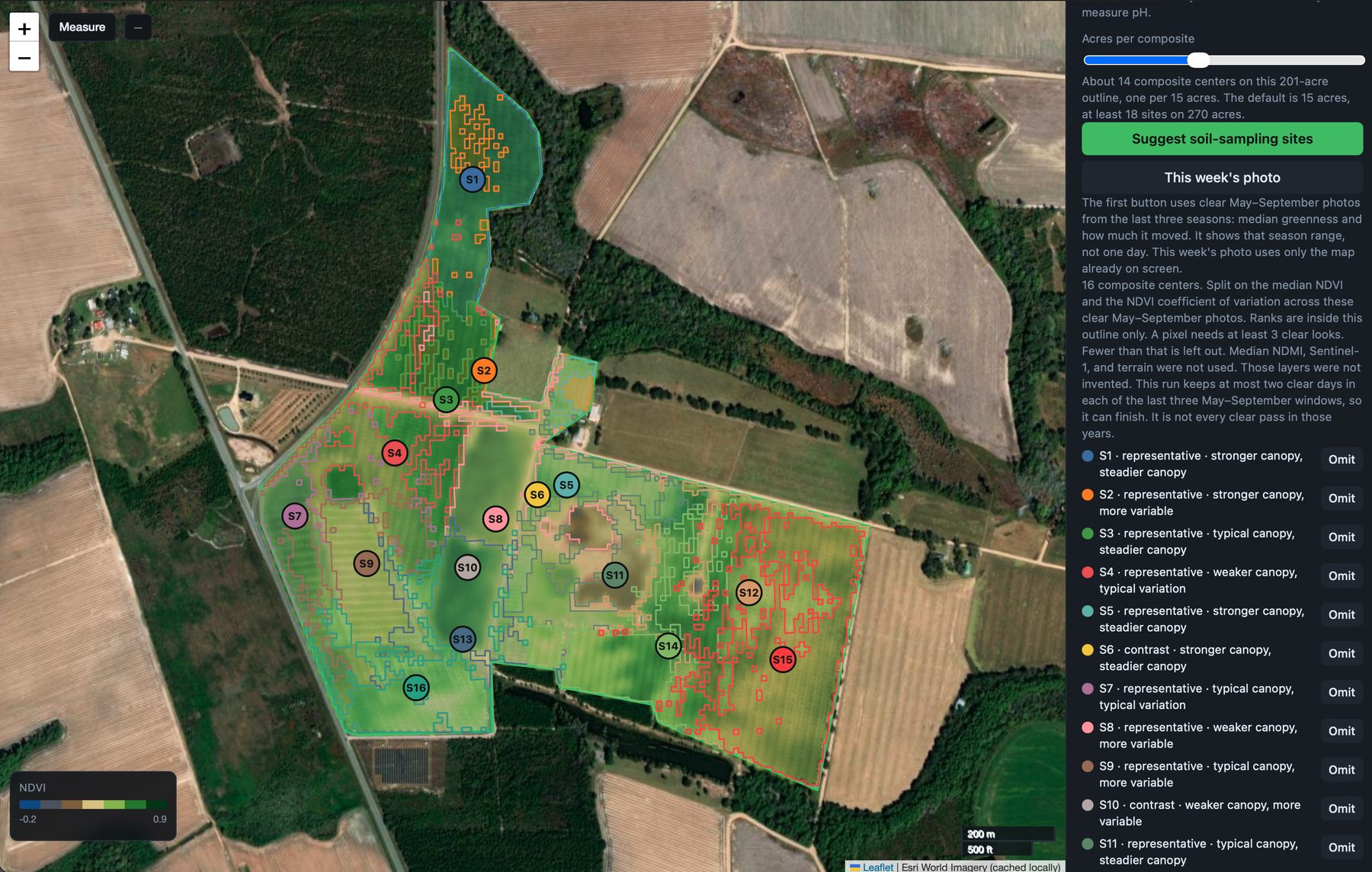
Prototype for this fall: the desktop tool places bags from multi-season canopy strata so lab cores (late fall or winter) can measure pH and nutrients across unlike parts of the orchard. Satellites do not read pH; the lab does. Fruit-body scouting still happens on the ground.
Lab soils, not a picture from space
Pecan truffles (Tuber lyonii) grow underground with pecan roots. Satellites cannot see them. What free Sentinel-2 time series can do is map unlike areas inside an orchard — steadier versus patchier canopy greenness across many clear dates — so soil cores represent real differences instead of one lucky (or unlucky) bag.
Research on commercial pecans found that Tuber on roots is more common where soil pH (and related mineral nutrients) is higher. That is an association from lab-tested soils, not a picture from space (Ge et al. 2017).
University of Georgia guidance already asks growers to sample uniform areas, usually no more than about 15 acres per composite, with 15–20 cores to 6–8 inches, preferably in late fall or winter (B1304, fertilization notes, Soil Test Handbook).
The desktop tool suggests sample pins and strata from a multi-year May–September median NDVI and its variability (temporal CV), with optional radar and terrain layers for wetness and drainage contrast. Those pins are places to dig for the lab. Fruit bodies still need dogs, or a careful search on the ground, in season. Yield cannot be predicted from the Ge paper alone.
What they have sold for
A transparent, regularly updated orchard-gate or wholesale price per pound for fresh T. lyonii is scarce. Named sellers often say to ask. The figures below are what those public sources actually say, with the date and the channel. They do not collapse into one worth-this-much-per-pound headline.
Pecan truffles are a real secondary crop in some Southeastern orchards, sold fresh to chefs and specialty buyers when supply exists. Land-grant and researcher sources have long cited commercial sales around $10–20 per ounce (about $160–320 per pound) — a range still on UF/IFAS PP330 as of September 2026, and echoing SARE's citation of Smith et al. 2012. Mid-2010s Georgia trade coverage put chef-facing prices roughly $200–500 per pound, with orchards moving tens of pounds in a good season. Current public per-pound lists are scarce: some named sellers only quote on request; at least one specialty retail listing in September 2026 showed $79 per ounce under "extremely limited" availability — scarcity retail, not a wholesale benchmark. Older restaurant buy prices (for example $100 per pound around 2003) are historical. None of these figures mean satellites can find fruit bodies or forecast pounds per acre.
Treat about $160–320 per pound as the long-cited extension and researcher commercial range, not a 2026 USDA market quote. PP330 is the land-grant page to cite. The page's own date is 25 September 2019, it was modified 12 August 2025, and the $10–20 per ounce text was still there when checked 21 September 2026 (ask.ifas, EDIS, PDF). The same range is what SARE OS13-082 attributes to Smith et al. 2012. Funds for that project were awarded in 2013; the projected end was 2016. A Florida Museum piece from 23 August 2018 quotes $160–300 per pound, and a remark that high-density orchards might raise per-acre profit by up to about 20 percent. Noble Research Institute (published 11 December 2020, modified 23 September 2024) repeats $10–20 per ounce next to European truffles at $69–225 per ounce.
The Georgia chef-market numbers are a separate, older set. Farm Progress, 18 November 2015, quotes Brenneman at $200–300 per pound. The Atlanta Journal-Constitution, updated 28 April 2018, reports sales at $200–500 per pound, chefs buying (Halyards / St. Simons among the examples), and Pecan Ridge at about 25–30 pounds a year. Garden & Gun, October/November 2015, describes a season of about 30 pounds as "worth several thousand dollars," naming restaurants such as Liam's and Five & Ten. A UGA Field Report reprint of an AP story from about 2002–2003 has Elizabeth on 37th buying from Magnolia Plantation at $100 per pound. That figure is historical. Do not read it as a current price.
Scarcity retail is a third channel. Do not average it with the extension range or with an orchard wholesale price. Foraged.com listed $79.00 per ounce when checked 21 September 2026, marked extremely limited, overnight shipping extra, wholesale available on inquiry. Forager Chef (30 December 2023, modified 2 November 2024) describes paying $70 per ounce and calls that a scarcity price. The literature range cited there is $160–400 per pound. A guess on that page of a future equilibrium near $20 per ounce is the author's guess. Sixteen times the $79.00 ounce listing is about $1,264 per pound; sixteen times the $70 anecdote is about $1,120 per pound. That arithmetic is not a quoted wholesale price, and it is not the extension range. Carolina Truffières offers fresh T. lyonii and says to ask for a price list. Pecan Ridge Plantation takes hunts and purchases by inquiry. Neither posts a public per-pound price.
Yield stories are illustrative only, never a farm budget. Smith and Brenneman, quoted in the SARE report, say some orchards can produce two or more pounds per acre per year — a personal observation. PP330 notes that collectors sometimes find many pounds in a few hours at certain Georgia orchards, again as personal observation. The older Field Report coverage is the patchy version: “close to a pound under some trees and none under others.” The same SARE report notes that haphazard root sampling correlated poorly with production. Dogs beat rakes for mature fruit. Multiplying any of those pounds by any of those prices is not a promise of acre revenue.
Coleman et al. 2024 reviews North American truffle science and treats T. lyonii as a species complex. It does not publish a T. lyonii per-pound series.
Limits
- Not a pH map. Imagery does not measure soil pH, lime requirement, or Mehlich nutrients.
- Not a truffle map. No published remote-sensing method detects T. lyonii fruit bodies. European brûlé and black-truffle methods do not transfer under mature pecan canopies.
- Imagery places sample sites. Multi-year May–September Sentinel-2 median NDVI, plus temporal CV, only helps draw representative and contrasting strata so unlike soils are not mixed into one bag. Optional Sentinel-1 or a DEM can add wetness and drainage contrast. That is still a sampling plan.
- Lab chemistry required. UGA-style composites — about 15 acres or less, 15–20 cores, 6–8 inches, late fall or winter — go to a soil-test lab (UGA AESL is the lab the handbook is written for).
- Fruit bodies are not visible from space. Harvest still needs dogs or a careful ground search in the moisture-gated season. In the Southeast the peak is often August–September.
- Ge et al. 2017 is not a yield model. Higher pH associates with more Tuber on sampled roots. That does not predict pounds of truffles per acre. Liming targets for pecans remain a fertility decision, separate from any truffle score.
- Value figures are not a guarantee. The per-pound prices and the pounds-per-acre notes above are dated, channel-specific, or anecdotal. Markets are thin and supply-limited.
Sources
- Ge et al. 2017, Plant and Soil — pH and mineral nutrients associated with Tuber on commercial pecan roots.
- UF/IFAS PP330, The Pecan Truffle — EDIS, PDF.
- UGA Soil Test Handbook, B1304, fertilization notes.
- SARE OS13-082 — Smith et al. 2012 range, and the pounds-per-acre observation.
- Florida Museum, 23 August 2018.
- Noble Research Institute, 11 December 2020.
- Farm Progress, 18 November 2015.
- Atlanta Journal-Constitution, updated 28 April 2018.
- Garden & Gun, October/November 2015.
- UGA Field Report / AP, about 2002–2003 — historical $100 per pound buy.
- Foraged.com listing, checked 21 September 2026.
- Forager Chef, 30 December 2023.
- Carolina Truffières and Pecan Ridge Plantation — price on request.
- Coleman et al. 2024, Plant and Soil — review only; no T. lyonii price series.

Comments