Kompressed · PACE
Aft of the wing
A quiet note. About 81 MB of video down to about 4 MB for a text or share send. A window aft of the wing is geometry, not permission to leave cellular on.
When cabin satellite internet — ViaSat, Starlink Aviation, or the same kind of service — is down, a window aft of the wing is a clearer geometry than a seat over the wing if you are thinking about terrestrial radio through the glass. The wing and fuselage shadow, diffract, and scatter. Sitting past the trailing edge takes one metal surface out of some look-down angles. It does not create a link. Kompressed does not create one either. For this note the file is a video: ~81 MB → ~4 MB, so a text or share send has a chance to finish when a lawful pipe exists. That is the Contingency rung on a PACE card, after cabin Wi-Fi, and only where the rules allow the radio to be on.
The situation
| Piece | Detail |
|---|---|
| Setting | A jet at cruise. The cabin Wi-Fi portal is dead. |
| Seat | Window, aft of the trailing edge. Not over the wing. |
| File | A video of about 81 MB. |
| What you send | The compressed clip, about 4 MB, plus a short text. Only if that send is lawful. |
| Primary pipe | ViaSat or Starlink Aviation cabin Wi-Fi — out. |
| What success looks like | The clip arrives and can be interpreted. Not a master file. |
Airplane mode stays on unless the aircraft provides an approved system that controls handsets. The rule is in the next section, next to the radio story.
Window, wing, and sidelobes
Airplane mode stays on unless the aircraft itself provides an approved system that controls handsets. 47 CFR §22.925 prohibits operating a Part 22 cellular telephone while airborne. A 2005 FCC notice recorded that PCS (Part 24) and WCS (Part 27) sit outside that section. FAA Advisory Circular 91-21.1C tells operators to have passengers turn cellular functions off, or use airplane mode, while airborne. The airline briefing binds you on its own. This page is a PACE note for a compressed clip when cabin Wi-Fi fails. It is not advice to leave a cellular radio on in flight, and it is not permission to ignore the safety briefing. If no lawful path is up, keep the clip and send it later: gate Wi-Fi, an approved onboard system, or cellular after landing.
An over-wing window sits in the wing's shadow for many look-down rays. A window aft of the trailing edge can face weaker upward sidelobes of a sector that is tilted down at the ground. The drawings are geometry. They are not a measured cruise link, and they state no decibel gain.
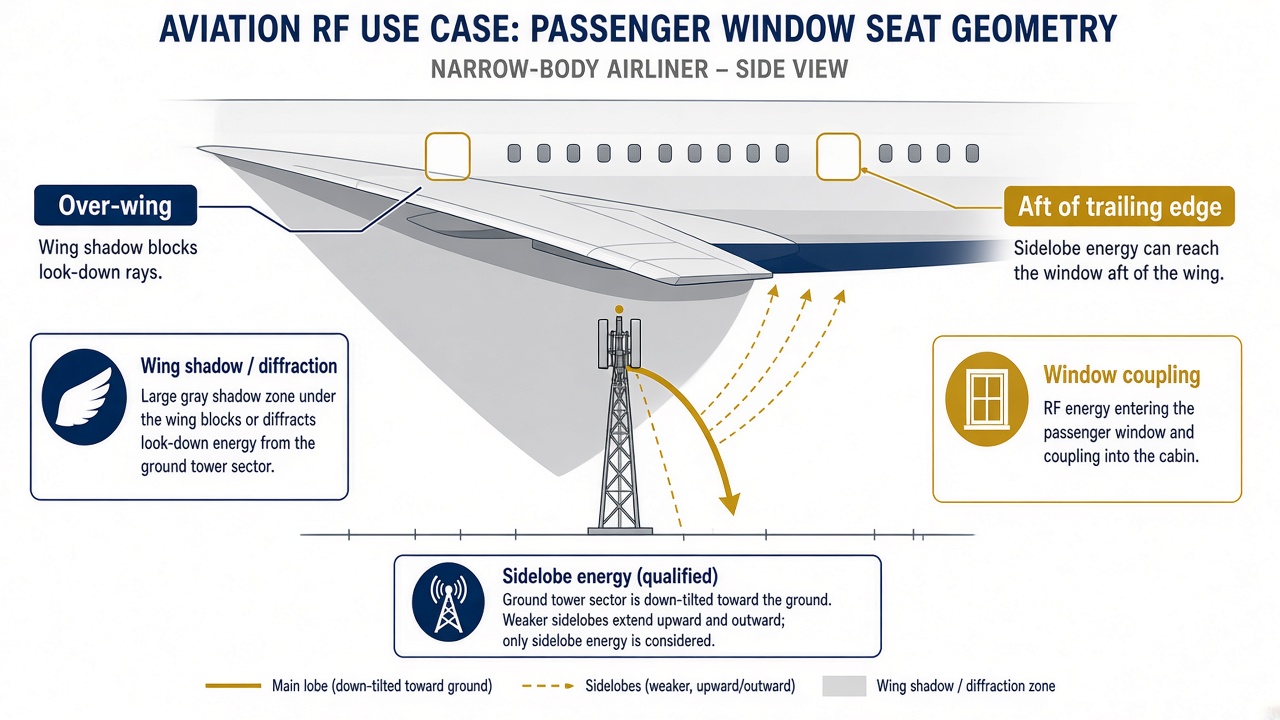
Side view, schematic only. Sidelobes are qualified: upward energy from a down-tilted sector, not the main beam, and not a link budget. The wing and fuselage shadow, diffract, and scatter. They are not a ground plane for the handset. No decibel figure belongs on this drawing.
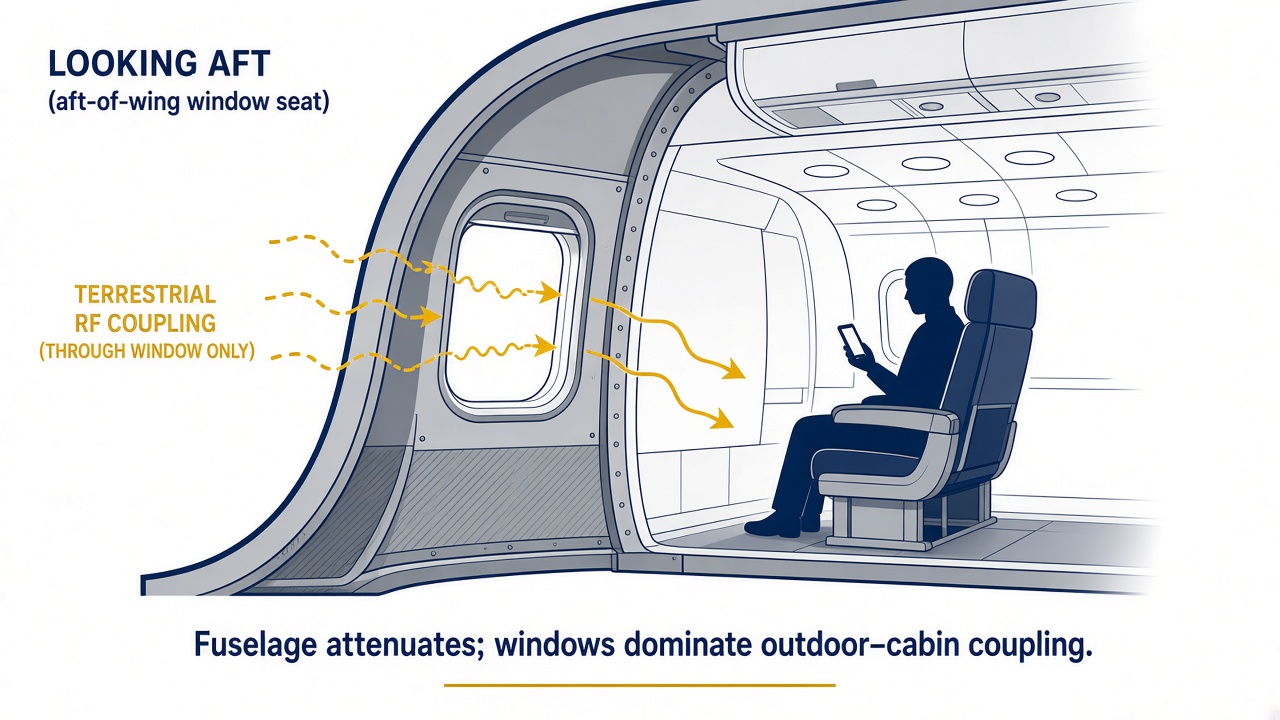
Looking aft, schematic only. The metal fuselage attenuates. Outdoor-to-cabin coupling is dominated by the window. Same limits as the side view: qualified sidelobes, no invented gain, not a coverage plot, and not an instruction to leave the radio on.
What the measurements support
- Cabin windows dominate outdoor-to-cabin coupling. The metal skin attenuates, and that attenuation is directional, not one number. ITU-R Report M.2283 (2013) treats windows as the main leakage path for systems in the cabin. ECC Report 175 uses the same viewing-angle idea. Cite those reports. Do not collapse them into a single airplane dB.
- Wings shadow. Moraitis, Constantinou, Pérez-Fontán, and Valtr, in the EURASIP Journal on Wireless Communications and Networking (2009), measured a Boeing 737-400 on the ground at 1.8, 2.1, and 2.45 GHz. Where the wing shaded the transmitter, average entry loss was about 4.8 dB larger. Their model used about 6 dB for grazing knife-edge diffraction on windows above the wing. That is a ground campaign, not a cruise handset result.
- A window aft of the trailing edge is geometrically friendlier for many look-down angles than a seat over the wing, because less wing sits in the path.
- Terrestrial cellular energy can reach altitude through sidelobes of down-tilted sector antennas. Kassas and coauthors, at the IEEE Aerospace Conference in 2022, flew a Beechcraft C-12 with an external receiver on 3G and 4G. They reported carrier-to-noise density of about 25–55 dB-Hz between roughly 2,000 and 23,000 feet above the ground, and tower tracking out to about 50 km horizontally near 16,000 feet. UAV work and 3GPP TR 36.777 describe altitude links as interference-limited: many cells can be in line of sight, so a strong receive level can fail as a data session. Cherif and Nadeem, arXiv:2503.20296, is in that vertical-pattern literature. It is not a cabin measurement.
What to keep qualified
- The wing and fuselage are large conductive bodies. They shadow, diffract, and scatter. They are not a ground plane built for a phone. A bounce off the skin is incidental multipath. It can help or hurt. It does not focus the cabin.
- A handset at FL300–FL400, behind a window, with a working uplink, is an extrapolation. The Kassas flights used aircraft antennas and stopped near 23,000 feet above the ground. Downlink energy over a dense region can exist. A usable upload of this clip through a cabin window is opportunistic, intermittent, and not a service level.
- Bars are not a finished send. A flickering downlink is not an uplink that completes a clip of about 4 MB. Doppler, interference, and a connection that keeps restarting are the hard part.
- Certified air-to-ground, Gogo-class and similar, uses aircraft antennas and a purpose-built ground network. A passenger phone aimed at an ordinary macro sector is a different system.
Seat and row cheat sheet
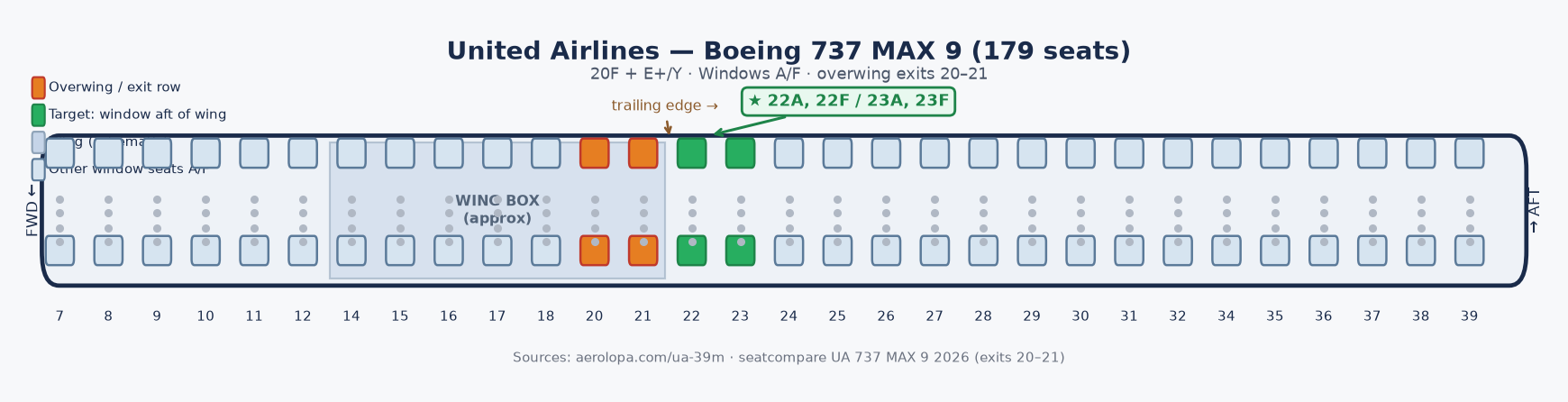
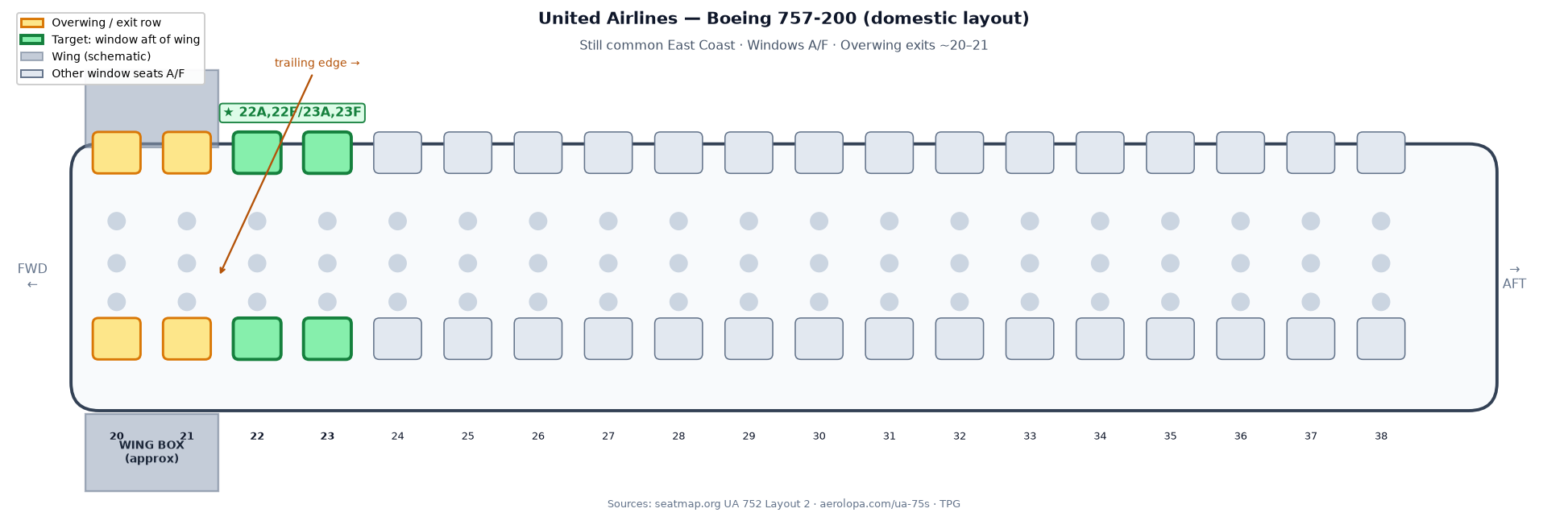
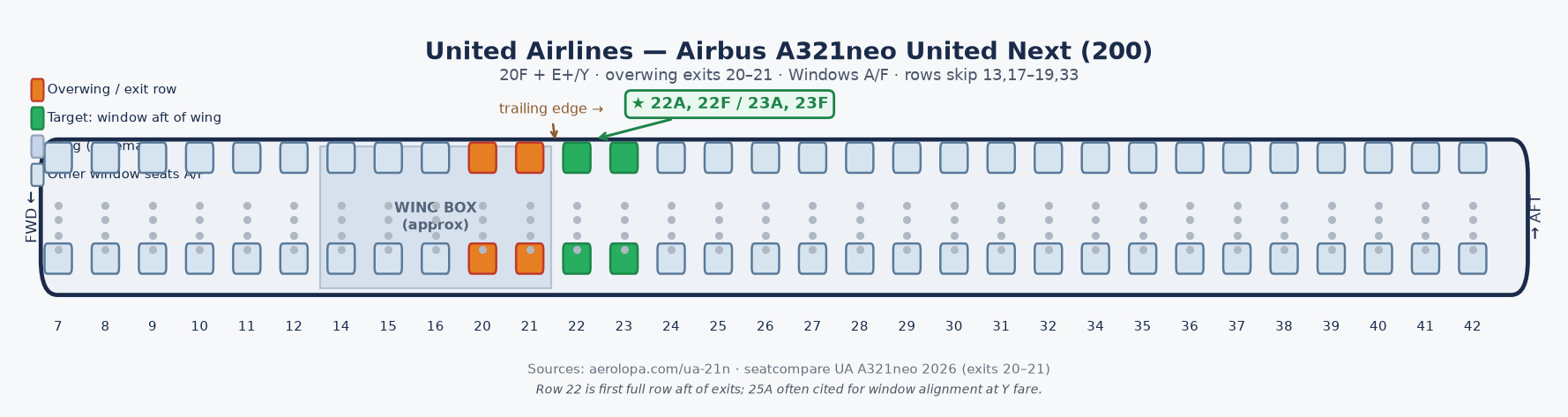
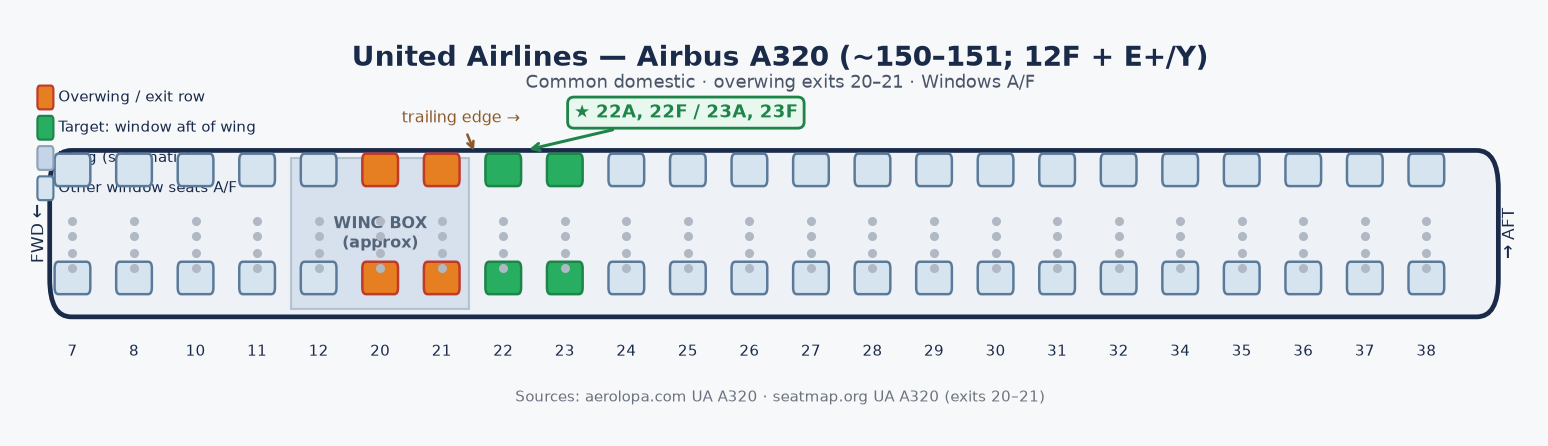
Wing position versus cabin row varies by airline interior, skipped rows, and subfleet. Overwing exit doors are a useful proxy for "over the wing," and the aft overwing exit is usually at or just ahead of the trailing edge. The first one or two window rows behind that exit are the practical aft-of-wing picks. Re-check the exact seat map in the airline app for that flight. Substitutions and refits change the numbers. The drawings below are approximate geometry for planning, not certified aircraft drawings.
On US narrow-bodies the window seats are almost always A and F. Alaska boards as F through A facing aft. The windows are A and F there too.
| Airline | Aircraft (common config) | Overwing / mid exit rows | Target window rows aft of wing | Seat letters | Primary source |
|---|---|---|---|---|---|
| United | 737-800 (166; 16F + E+/Y) | 20–21 | 22–23 | A, F | AeroLOPA ua-738-1 · seatcompare 2026 guide |
| United | 737 MAX 8 (166; 16F + E+/Y) | 20–21 | 22–23 | A, F | AeroLOPA ua-37e · seatcompare UA MAX 8 2026 |
| United | 737 MAX 9 (179; 20F + E+/Y) | 20–21 | 22–23 | A, F | AeroLOPA ua-39m · seatcompare UA MAX 9 2026 |
| United | 757-200 (domestic / refreshed) | 20–21 | 22–23 | A, F | seatmap.org UA 752 L2 · AeroLOPA ua-75s |
| United | A321neo United Next (200) | 20–21 | 22–23 | A, F | AeroLOPA ua-21n · seatcompare UA A321neo 2026 |
| United | A320 (about 150–151; 12F + E+/Y) | 20–21 | 22–23 | A, F | seatmap.org UA A320 · AeroLOPA UA A320 |
| United | A319 (126; 12F/114Y) | 21 | 22–23 | A, F | AeroLOPA ua-19s · seatcompare UA A319 2026 |
| American | 737-800 Oasis/Kodiak (172) | 16–17 (MCE exit) | 18–19 | A, F | AeroLOPA aa-738k · seatcompare AA 738 2026 |
| American | 737 MAX 8 Oasis/Kodiak (172) | 16–17 | 18–19 | A, F | AeroLOPA aa-7m8 · seatcompare AA MAX 8 2026 |
| American | A321 Oasis/Kodiak (190) | 11 (mid) · 24 (aft) | about 12–13 (just aft of mid) · 25 (aft of the door) | A, F | AeroLOPA aa-a321k · seatcompare AA A321 2026 · FlightQ AA A321 190 |
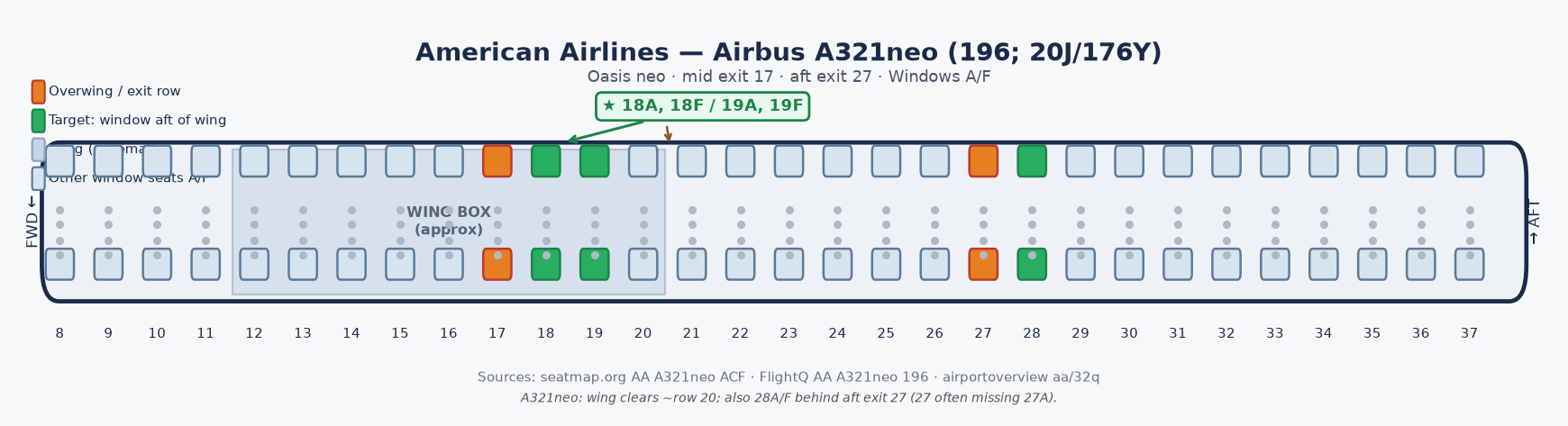
| American | A321neo (196; 20J/176Y) | 17 · 27 | about 18–19 · 28 | A, F | seatmap.org AA A321neo ACF · FlightQ AA A321neo · airportoverview aa/32q |
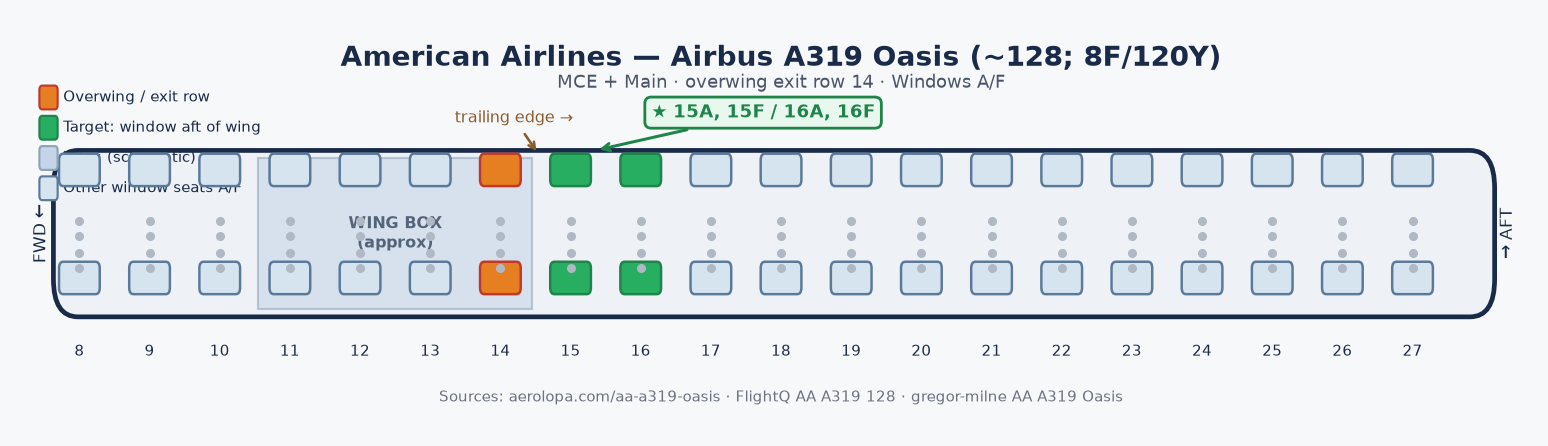
| American | A319 Oasis (about 128; 8F/120Y) | 14 | 15–16 | A, F | AeroLOPA aa-a319-oasis · FlightQ AA A319 |
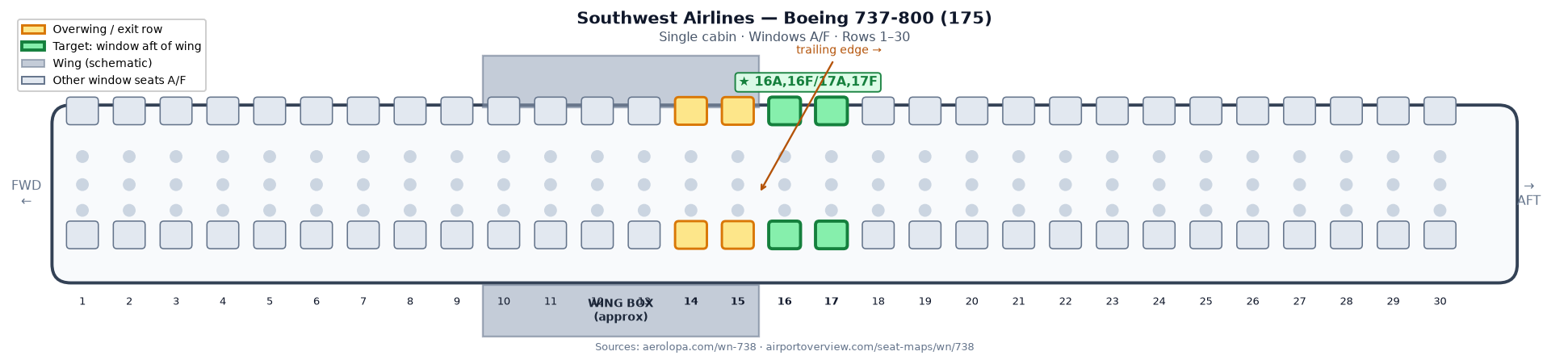
| Southwest | 737-800 (175 Heart / Elevated) | 14–15 | 16–17 | A, F | AeroLOPA wn-738 · airportoverview WN 738 |
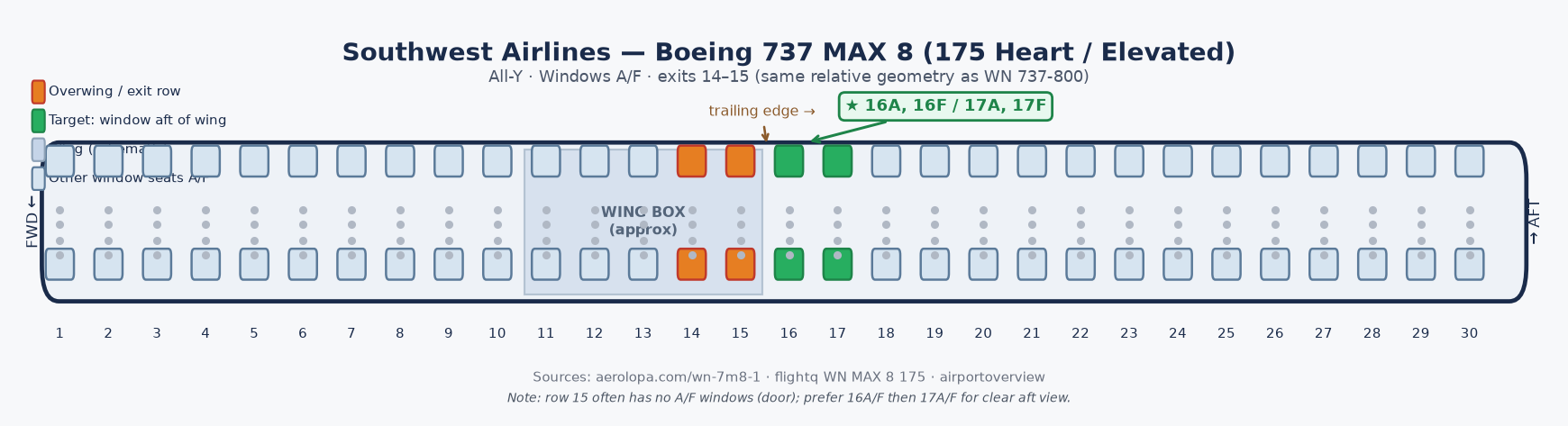
| Southwest | 737 MAX 8 (175 Heart / Elevated) | 14–15 | 16–17 | A, F | AeroLOPA wn-7m8 · FlightQ WN MAX 8 |
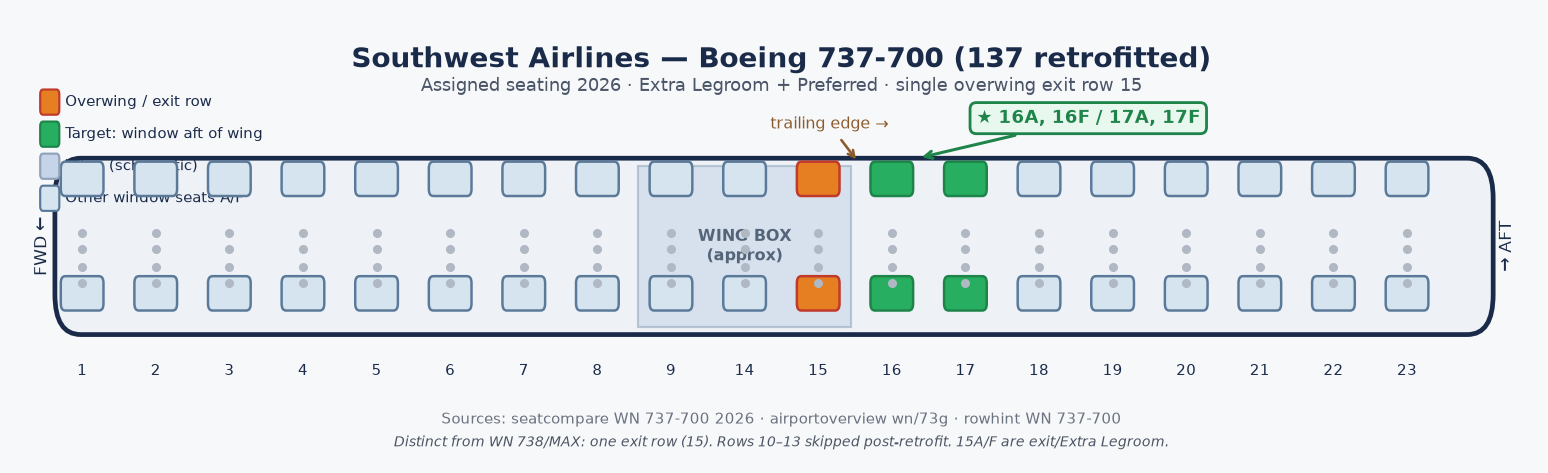
| Southwest | 737-700 (137 retrofitted) | 15 | 16–17 | A, F | seatcompare WN 737-700 2026 · airportoverview wn/73g |
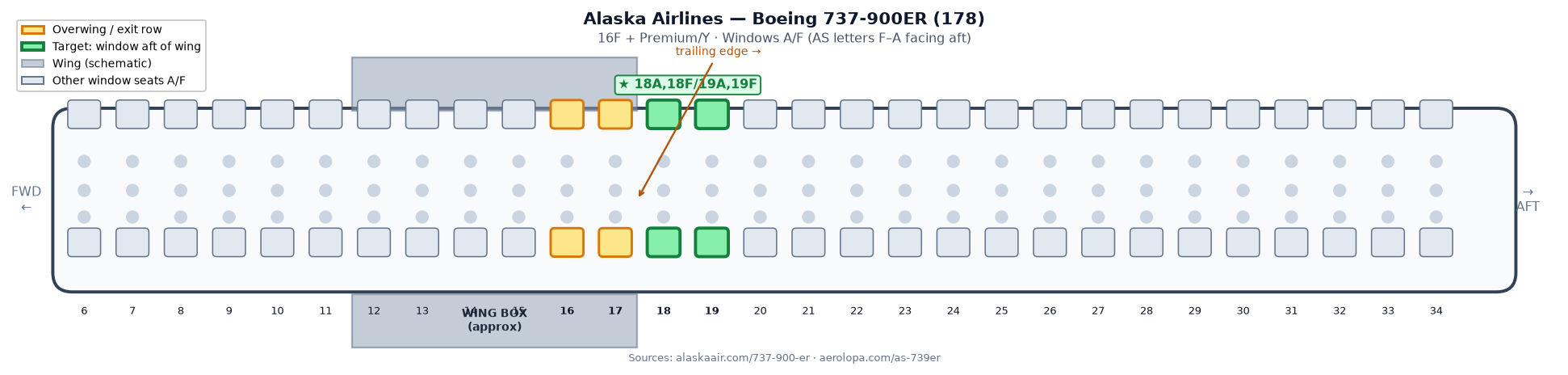
| Alaska | 737-900 / 737-900ER (about 178) | 16–17 | 18–19 | A, F | alaskaair.com 737-900ER · AeroLOPA as-739er |
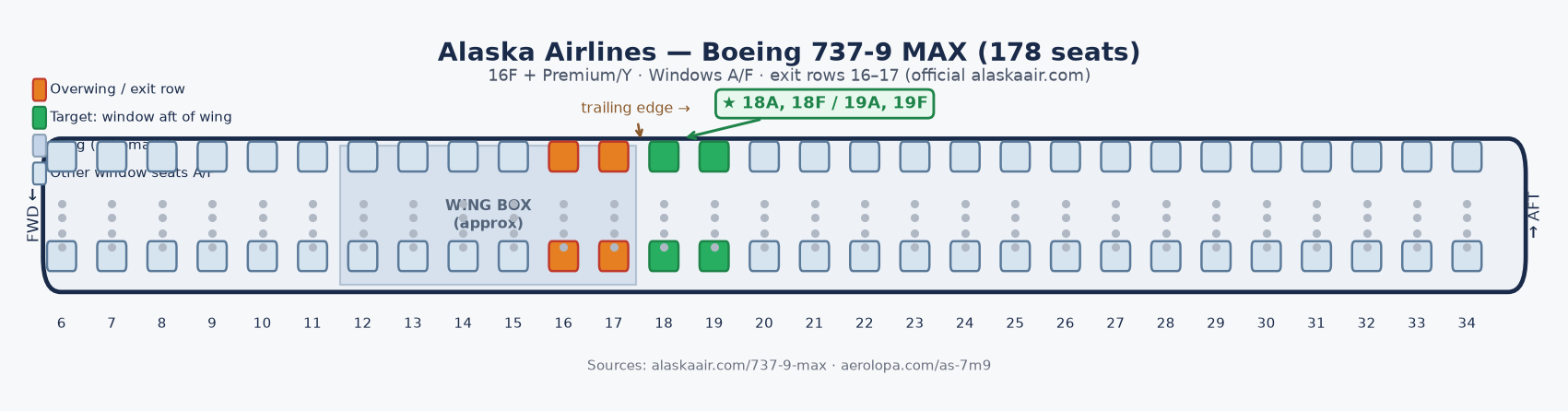
| Alaska | 737-9 MAX (178) | 16–17 | 18–19 | A, F | alaskaair.com 737-9 MAX · AeroLOPA as-7m9 |
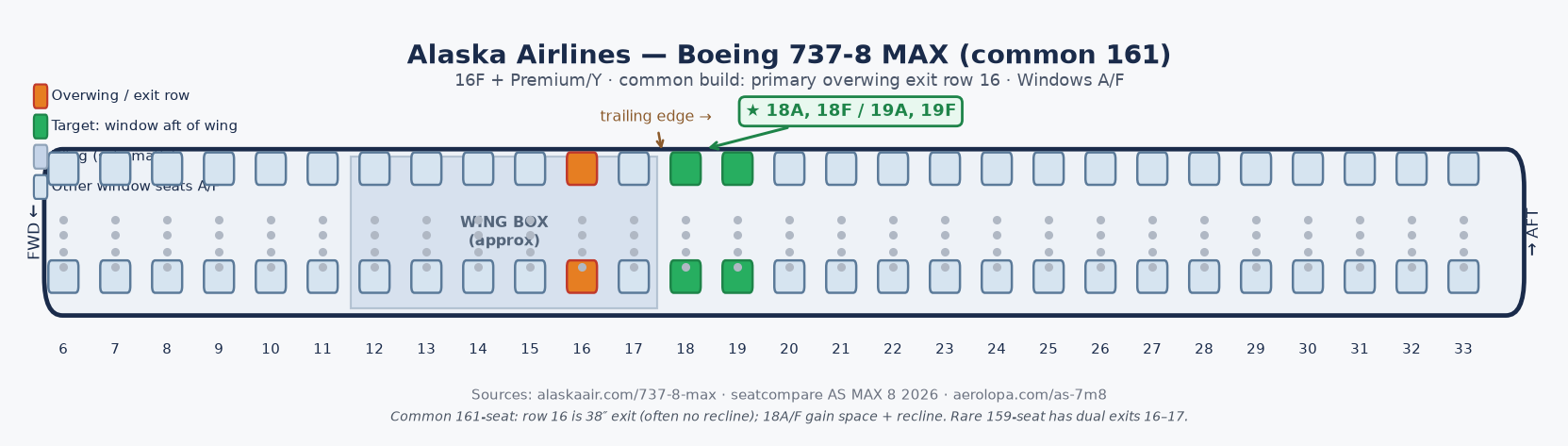
| Alaska | 737-8 MAX (common 161) | 16 (primary; 17/18 partial) | 18–19 | A, F | alaskaair.com 737-8 MAX · seatcompare AS MAX 8 2026 |
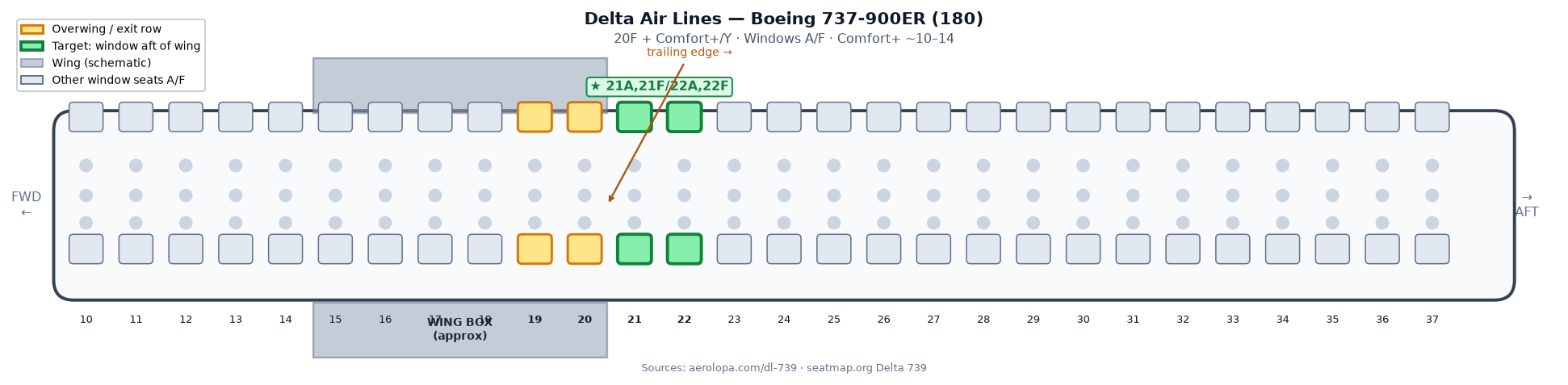
| Delta | 737-900ER (about 180; 20F + C+/Y) | 19–20 | 21–22 | A, F | AeroLOPA dl-739 · seatmap.org DL 739 |
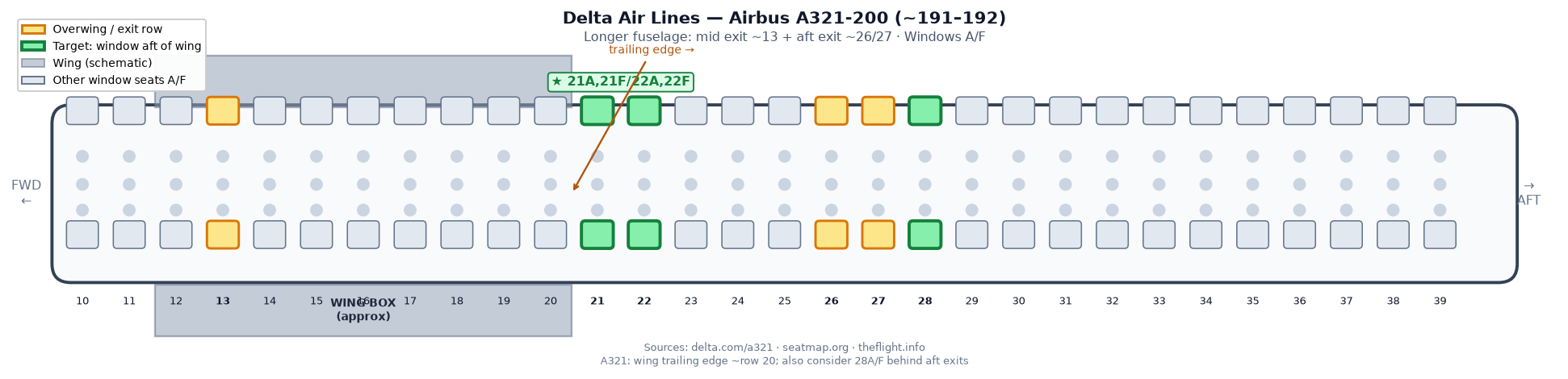
| Delta | A321-200 (about 191–192) | 13 (mid) · 26–27 (aft) | about 21–22 (clear of the trailing edge) · 28 (behind the aft exits) | A, F | delta.com A321 · seatmap.org DL 321 · theflight.info |
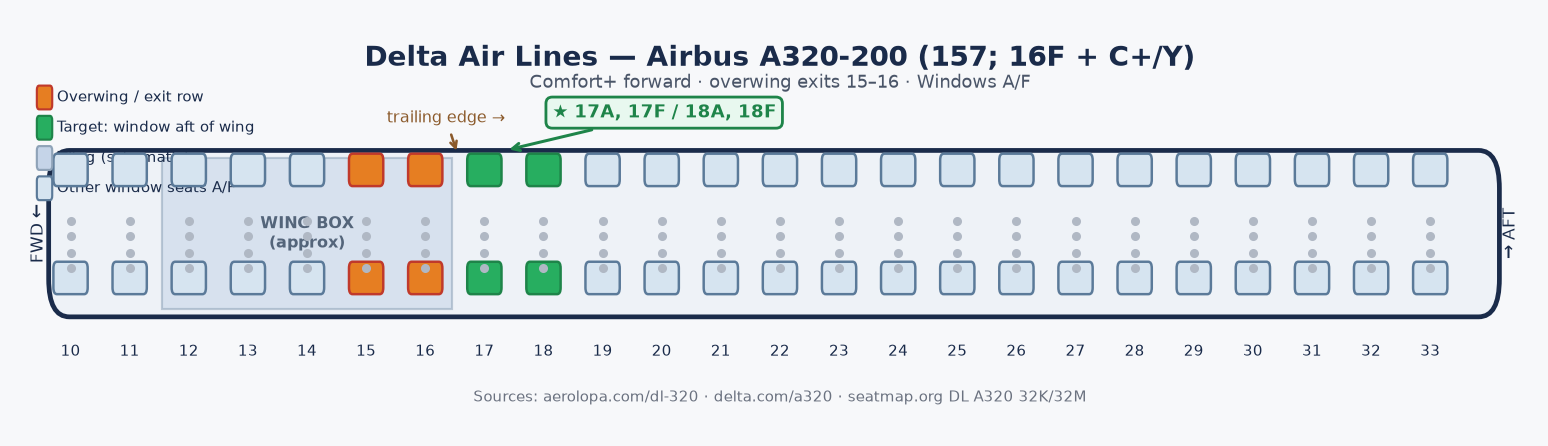
| Delta | A320-200 (157; 16F + C+/Y) | 15–16 | 17–18 | A, F | AeroLOPA dl-320 · delta.com A320 · seatmap.org DL A320 |
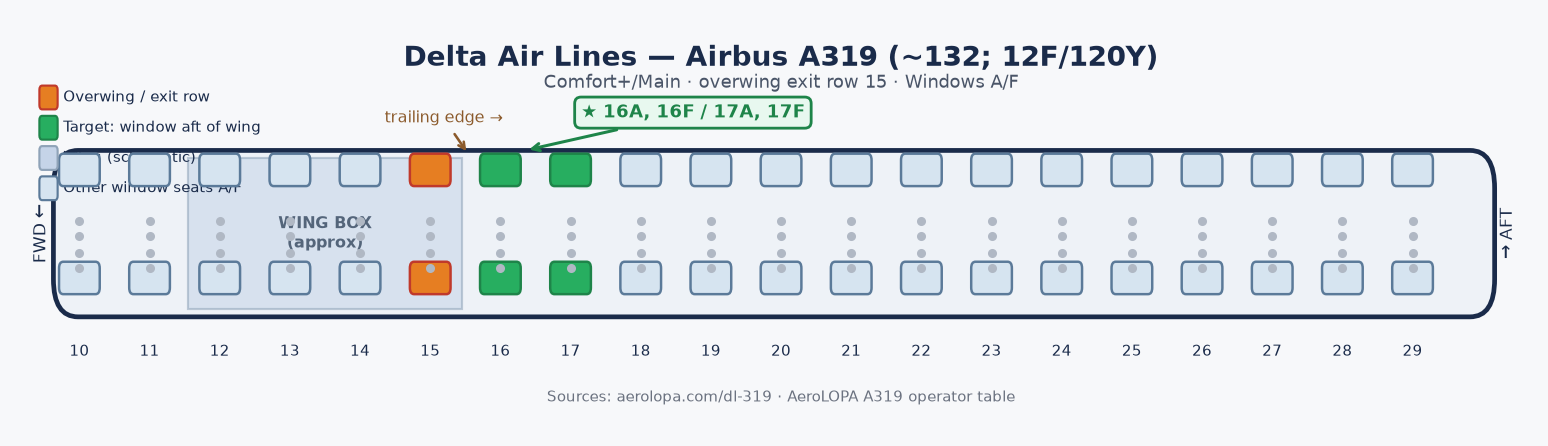
| Delta | A319 (about 132; 12F/120Y) | 15 | 16–17 | A, F | AeroLOPA dl-319 |
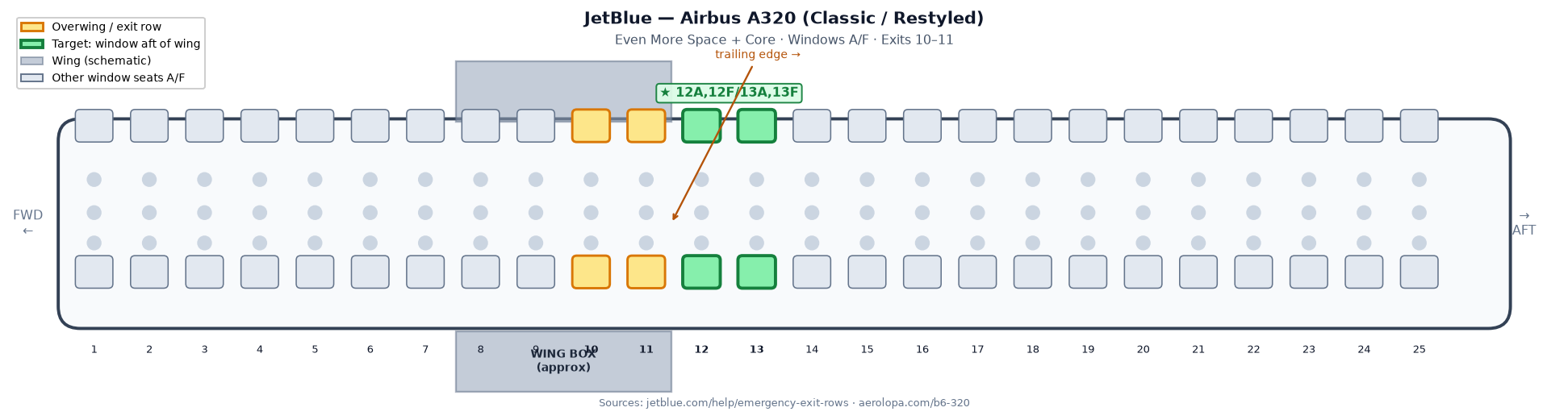
| JetBlue | A320 Classic / Restyled | 10–11 | 12–13 | A, F | JetBlue exit-row help · AeroLOPA b6-320 |
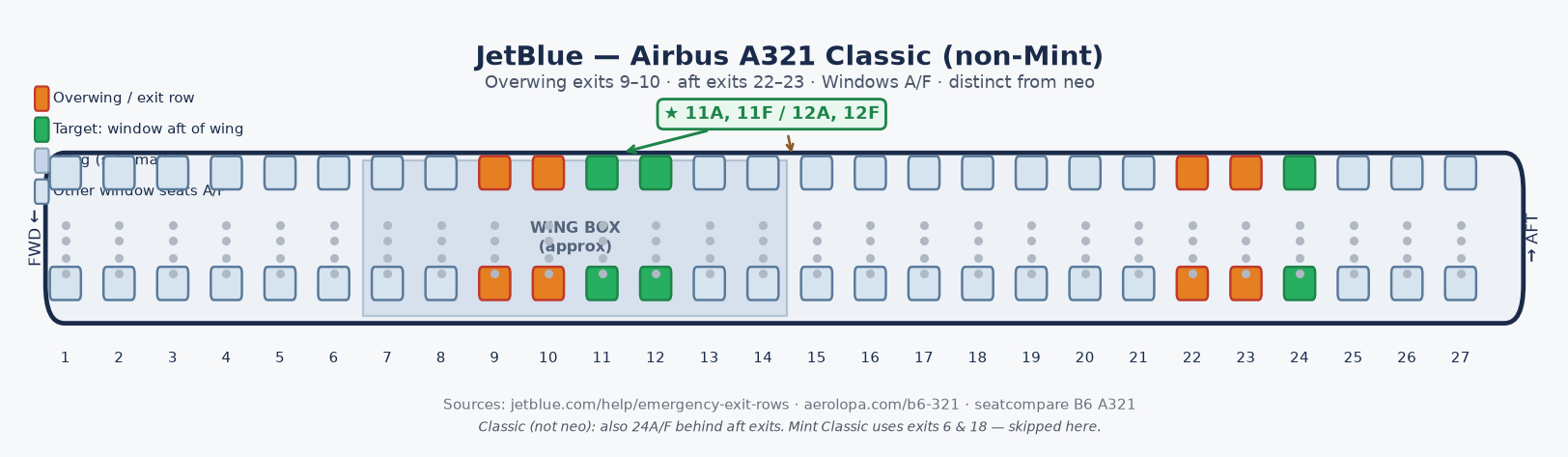
| JetBlue | A321 Classic (non-Mint) | 9–10 (overwing) · 22–23 (aft) | 11–12 · 24 | A, F | JetBlue exit-row help · AeroLOPA b6-321 |
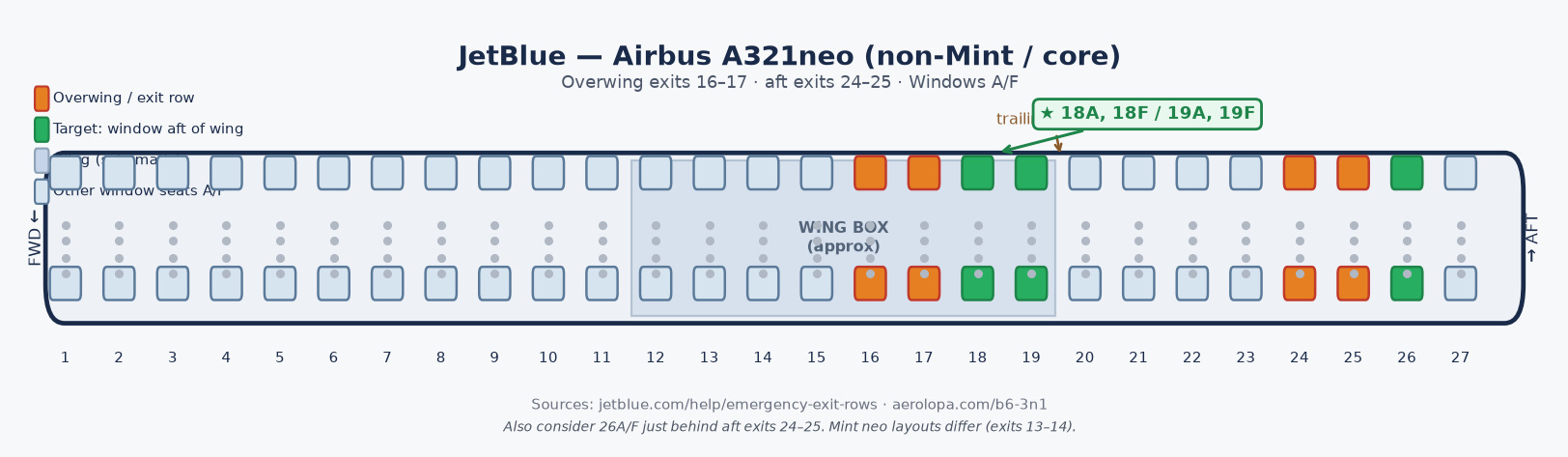
| JetBlue | A321neo (non-Mint) | 16–17 · 24–25 | 18–19 · 26 | A, F | JetBlue exit-row help · AeroLOPA b6-3n1 |
Top picks
When the booked airplane matches the row above:
- United 737-800, MAX 8, or MAX 9 — 22A or 22F, then 23A/F. Exits 20–21 on that United 737 family.
- American 737-800 or MAX 8 — 18A or 18F, then 19A/F. Oasis/Kodiak exits 16–17.
- Southwest 737-800 or MAX 8 — 16A or 16F, then 17A/F. Exits 14–15. Book the extra-legroom or preferred seat early.
- Southwest 737-700 — 16A or 16F, then 17A/F. One exit, at row 15, unlike the 800 and MAX 8.
- Delta 737-900ER — 21A or 21F, then 22A/F. Exits 19–20.
- Alaska 737-900ER or MAX 9 — 18A or 18F, then 19A/F. Exits 16–17.
- Alaska MAX 8 in the common 161-seat map — 18A or 18F, then 19A/F. Primary exit is 16.
- United A321neo — 22A/F. American A321neo — 18A/F, and 28A/F behind the aft door.
- JetBlue A320 — 12A/F. A321 Classic — 11–12A/F. A321neo — 18–19A/F.
Also useful when the map matches: United A319 or A320 at 22A/F, Delta A320 at 17–18A/F, American A319 at 15–16A/F, United 757-200 at 22A/F, Delta A321 at 21–22A/F.
Rule of thumb
- Find the aft overwing exit on the booking map. It is usually marked as an exit or as extra legroom.
- Take the next one or two window seats aft of it, A or F. That is usually past the trailing edge.
- Do not treat the exit row itself as clear of the wing. Those windows often look at the wing or the door.
- On an A321 there is usually a second pair of exits farther aft. The trailing edge is often ahead of that aft door, so both "just clear of the wing" and "behind the aft exits" can show up in the table, depending on the look-down angle.
- Confirm the type at check-in. East Coast trips swap 737 and A320-family airplanes often.
Row numbers move mostly because first class and premium depth change, and because some rows are skipped. The pattern on a 737 is aft overwing exit, then one or two windows. A MAX map for a given airline usually keeps that relationship (United MAX 8 like the 737-800, American MAX 8 like the 737-800, Southwest MAX 8 like the 737-800). The Southwest 737-700 is the exception here: one overwing exit, at row 15.
Shorter A319 and A320 cabins put the overwing exits near mid-cabin. A longer A321 keeps the wing near mid-cabin and runs the cabin well past it. The aft doors are not over the wing. Prefer windows just clear of the wing, not only "behind the last exit."
Not in this sheet
No drawing here for Delta 737 MAX types (no in-service domestic seat map verified for this note as of 1 October 2026), American 737 MAX 9 (American does not fly it), Southwest MAX 9 or MAX 7, JetBlue Mint cabins, American A321T or A321XLR, United A321XLR, or the ultra-low-cost and regional-jet fleets. Those maps are different products. Do not borrow a row number from the table above.
Schematics
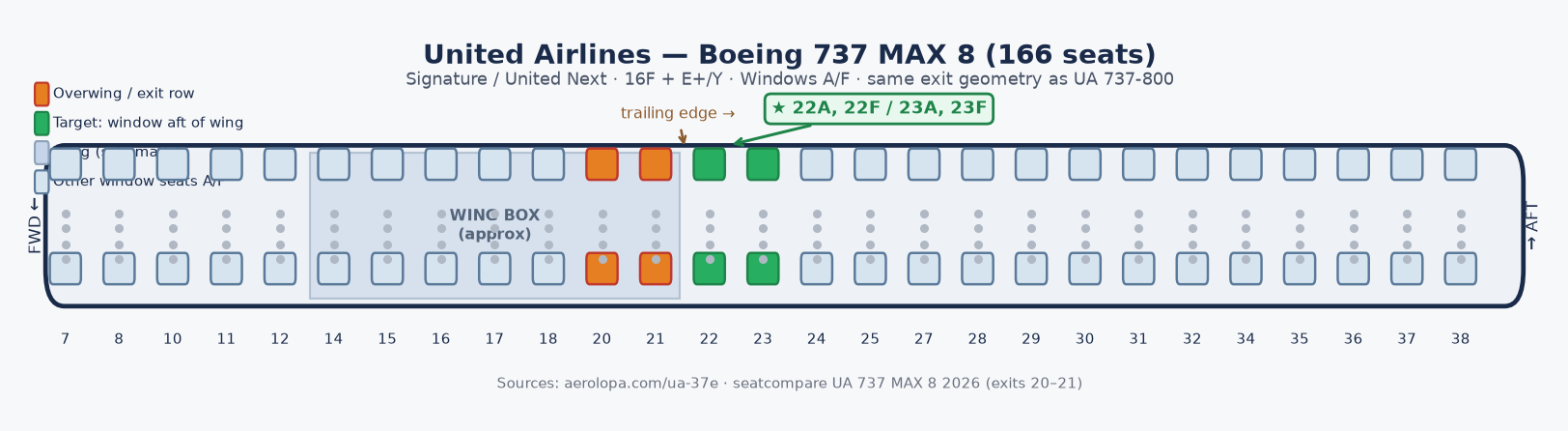
Twenty-five original row drawings. Each one is row numbers, a wing box, and highlighted A/F windows. They are not airline artwork and not a decibel map. Read the label, then confirm the airline app.
United
737-800. Windows 22–23 A/F, aft of exits 20–21.
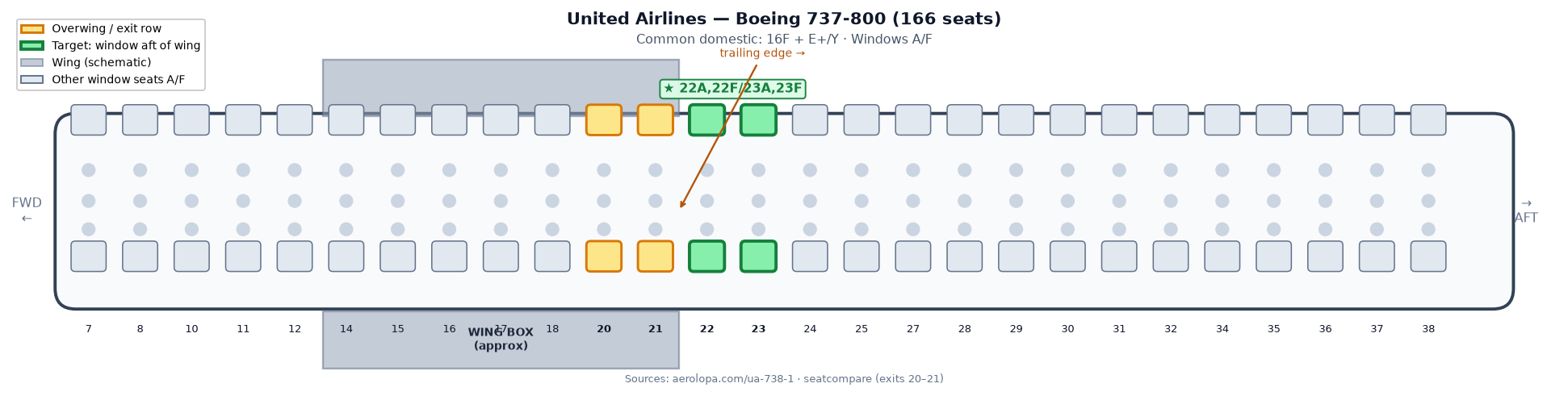
737 MAX 8. Windows 22–23 A/F, aft of exits 20–21.
737 MAX 9. Windows 22–23 A/F, aft of exits 20–21.
757-200, domestic. Windows 22–23 A/F, aft of exits 20–21. A Polaris cabin shifts the economy numbers. Check the layout.
A321neo, United Next (200). Windows 22–23 A/F, aft of exits 20–21.
A320. Windows 22–23 A/F, aft of exits 20–21.
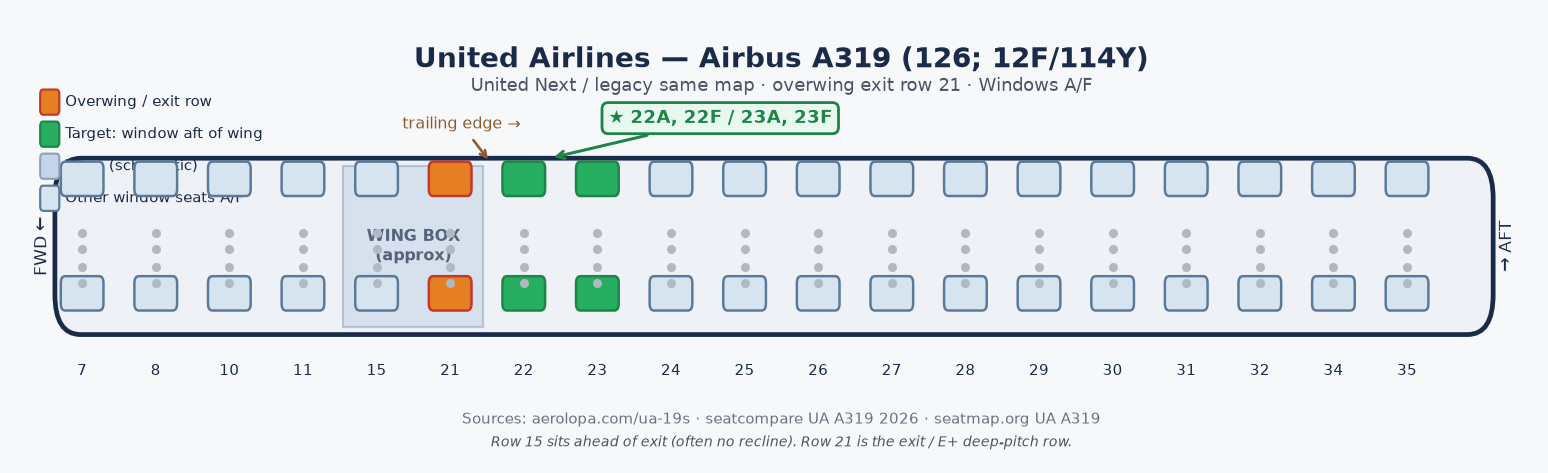
A319. Windows 22–23 A/F, aft of exit 21.
American
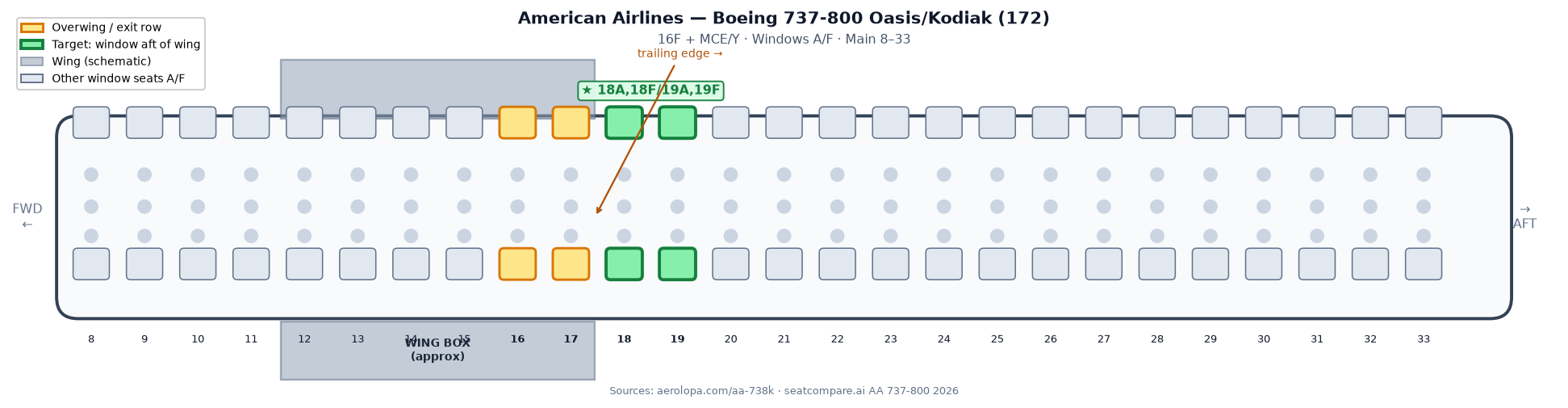
737-800, Oasis/Kodiak. Windows 18–19 A/F, aft of exits 16–17.
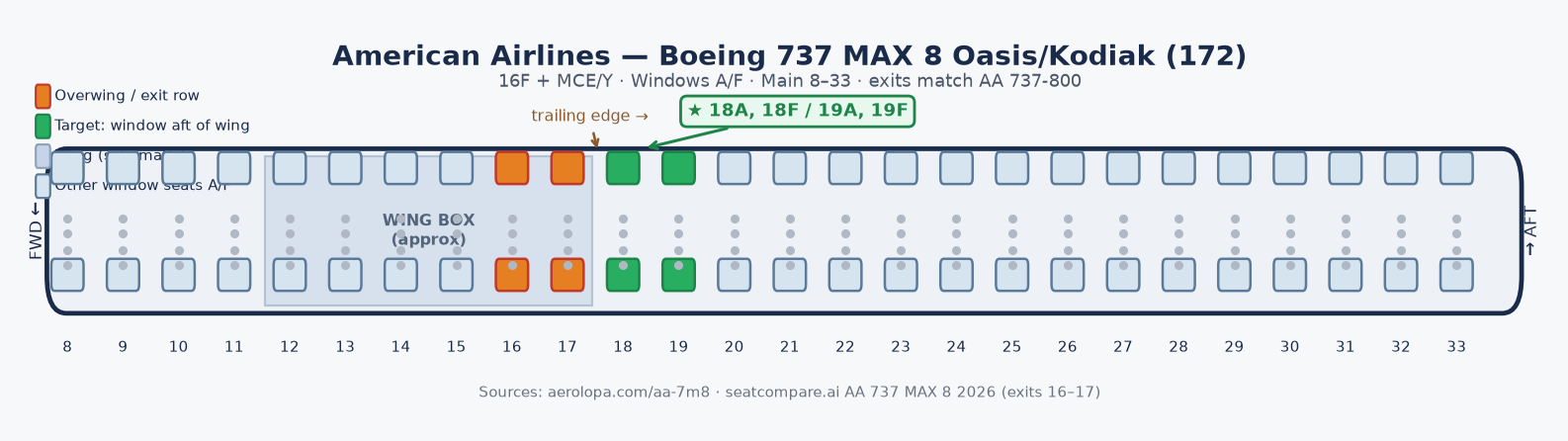
737 MAX 8, Oasis/Kodiak. Windows 18–19 A/F, aft of exits 16–17.
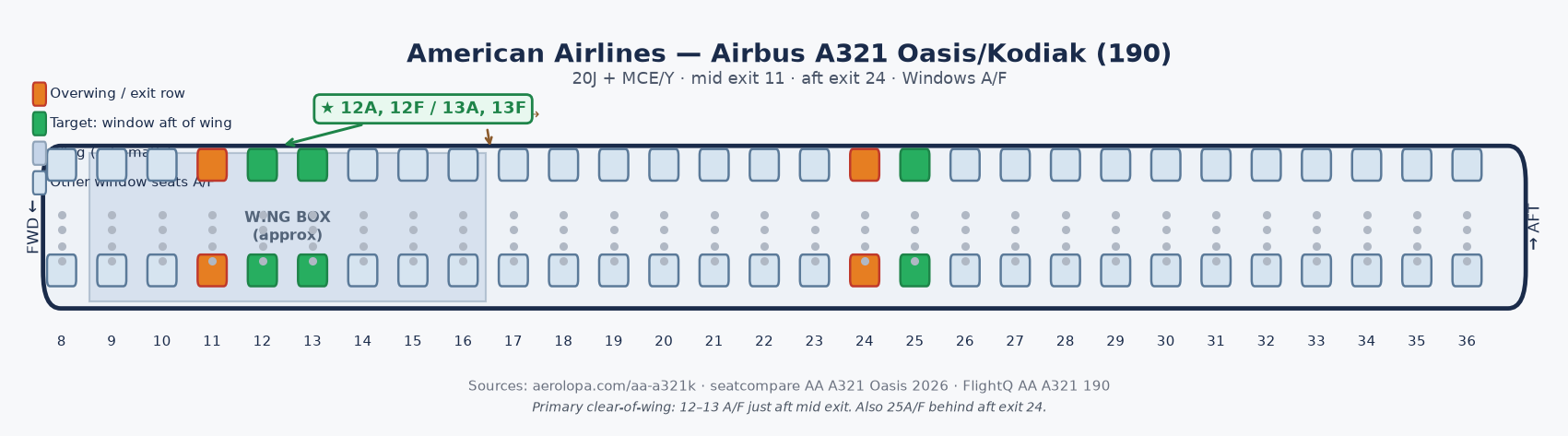
A321, Oasis/Kodiak (190). About 12–13 A/F just aft of the mid exit at 11, and 25 A/F aft of the door at 24.
A321neo (196). About 18–19 A/F, and 28 A/F behind the aft door. Exits at 17 and 27.
A319, Oasis. Windows 15–16 A/F, aft of exit 14.
Southwest
737-800. Windows 16–17 A/F, aft of exits 14–15.
737 MAX 8. Windows 16–17 A/F, aft of exits 14–15.
737-700. Windows 16–17 A/F, aft of the single exit at 15.
Alaska
737-900ER. Windows 18–19 A/F, aft of exits 16–17.
737-9 MAX. Windows 18–19 A/F, aft of exits 16–17.
737-8 MAX, common 161-seat map. Windows 18–19 A/F. Primary exit is 16. Rows 17 and 18 are partial on some maps.
Delta
737-900ER. Windows 21–22 A/F, aft of exits 19–20.
A321-200. About 21–22 A/F clear of the trailing edge, and 28 A/F behind the aft exits at 26–27. Mid exit at 13.
A320-200. Windows 17–18 A/F, aft of exits 15–16.
A319. Windows 16–17 A/F, aft of exit 15.
JetBlue
A320 Classic / Restyled. Windows 12–13 A/F, aft of exits 10–11.
A321 Classic, non-Mint. Windows 11–12 A/F aft of the overwing exits at 9–10, and 24 A/F aft of exits 22–23.
A321neo, non-Mint. Windows 18–19 A/F, and 26 A/F. Exits at 16–17 and 24–25.
Where the towers are registered
These two maps are infrastructure context for the Contingency rung. They are not cruise coverage, not sidelobe proof, and not a passenger signal at altitude.
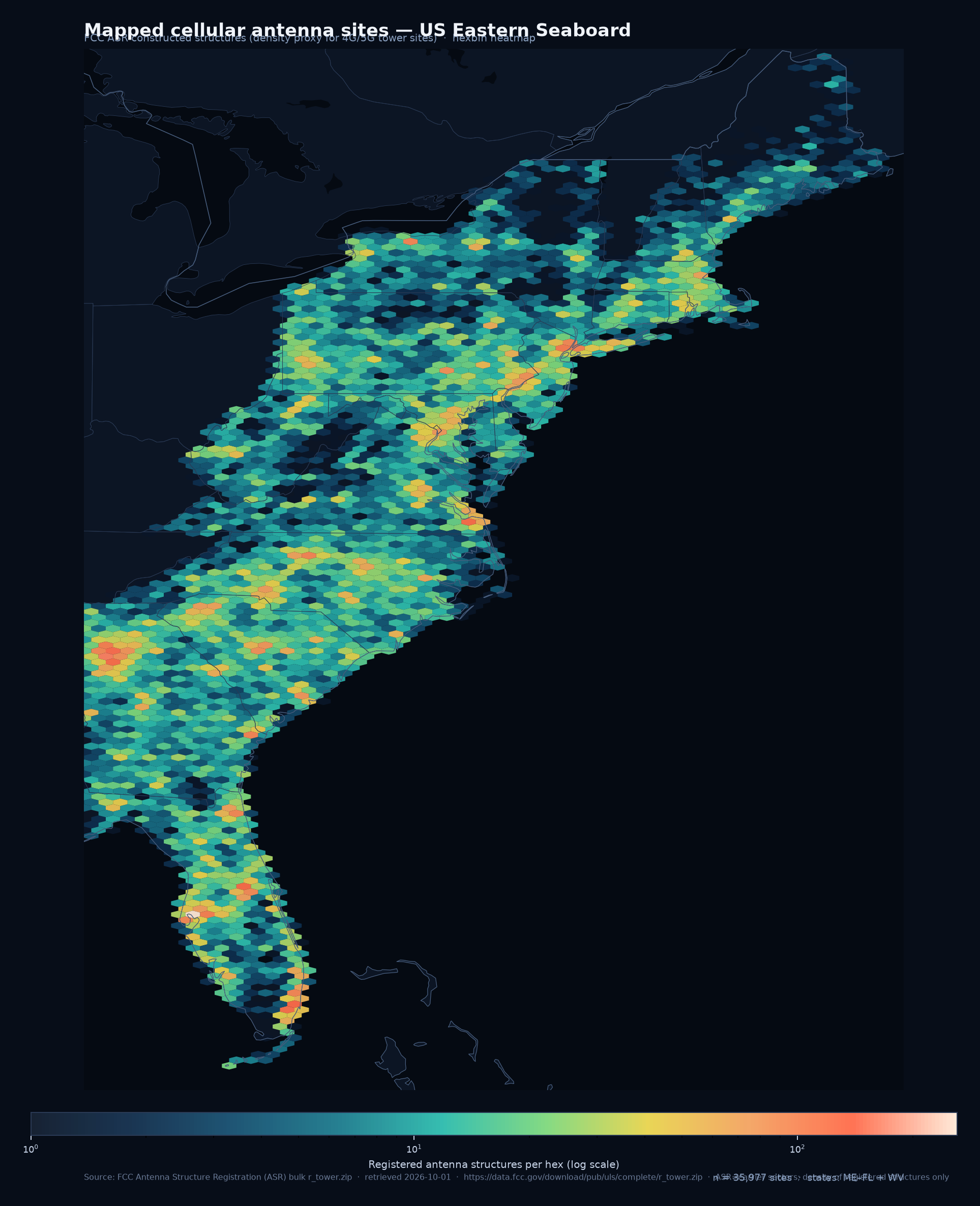
FCC Antenna Structure Registration, constructed structures only, retrieved 1 October 2026 from the FCC ULS bulk archive r_tower.zip (archive dated 27 September 2026). East Coast states from Maine through Florida, plus West Virginia, inside the map extent: 35,977 structures. Log-scaled hexbin density, not sector pins. A registration is a structure. It is not an operating LTE or 5G sector, not a coverage polygon, and not signal at altitude. OpenCelliD was not used.
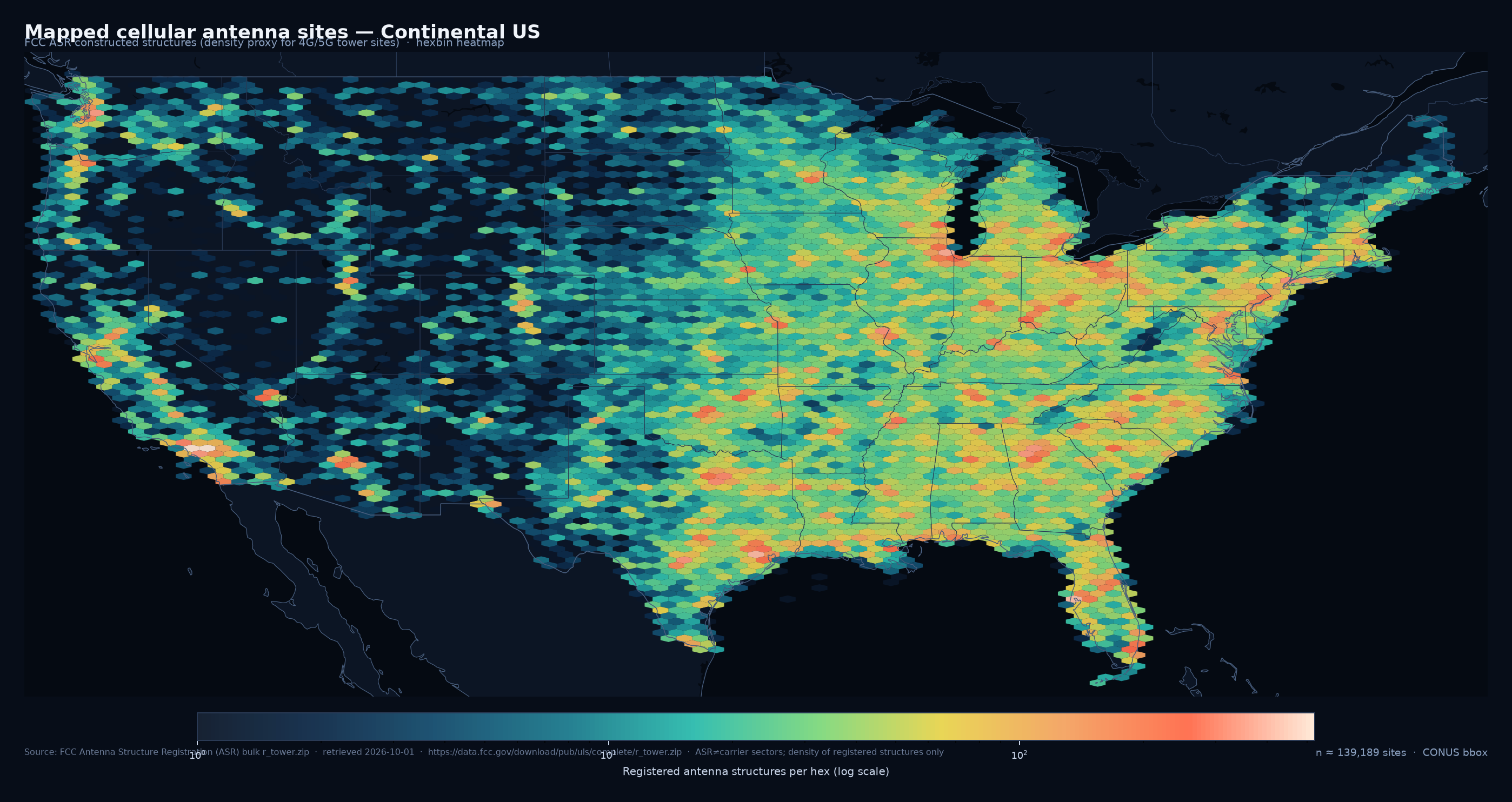
Same retrieval and the same constructed-structure filter, continental United States box: 139,189 structures. Density under a route is context for where registered structures cluster. It is not altitude coverage.
What Kompressed does with the clip
Kompressed does not make cellular coverage. It fits the file to a ceiling you name, on the phone, and then stops. The story size for this note is about 81 MB down to about 4 MB. The app prints the size it actually wrote. There is no chip on the store listing named for a wing seat or a sidelobe. Set the ceiling and read the number.
| Step | You | The app |
|---|---|---|
| 1 | Start with a video of about 81 MB. | |
| 2 | Set a hard ceiling. | Crops, scales, and encodes on the device until the file fits, and shows the size. The story result is about 4 MB. |
| 3 | Share. | Hands you the clip. It does not run the modem, and it does not leave airplane mode. |
| 4 | Send only where it is lawful. | The about-4 MB clip, plus a short text: "IFC down; here is the clip." |
| 5 | If the send fails. | Keep the clip. Retry on the next lawful window, or drop a rung. |
Storyboard
- Primary fails. Cabin Wi-Fi spins, the portal errors, or the crew says the system is out.
- Seat. Window, behind the wing, so the glass is not looking through the wing.
- Compress first. ~81 MB → ~4 MB. Read the size the app prints.
- Contingency, only where policy allows it. Send the about-4 MB compressed clip and a short text: "IFC down; here is the clip."
- If that fails, stop. Text by an approved path, or wait for descent and the gate. Do not turn a radio on to force the clip out.
- Afterward, note which rung actually worked.
PACE card
Order is precedence. Move down when the higher rung cannot finish the exchange in time. Prefer a Contingency path that does not depend on the failed cabin modem. Compress before you are in a hurry. Follow the briefing, Advisory Circular 91-21.1C, and the FCC rules that apply, including 47 CFR §22.925 for Part 22 cellular. This card is not permission to leave airplane mode on.
| Rung | Path | What it is | Kompressed | Leave it when |
|---|---|---|---|---|
| P — Primary | Cabin Wi-Fi: ViaSat or Starlink Aviation | Best passenger pipe on the airplane. Often throttled. | Story clip: about 81 MB in, about 4 MB out. Send it when this pipe is actually up. | Portal dead, upload fails, or the crew says Wi-Fi is out. |
| A — Alternate | Another cabin path if this tail has one, or gate Wi-Fi before pushback and after arrival | Real IP, different backhaul. Certified aircraft air-to-ground, if the airline offers it, is this rung, not your phone. | The same clip of about 4 MB. | That path is dead, or this airplane does not have it. |
| C — Contingency | A thin path only where it is lawful: an approved onboard system, or a short window you are allowed to use | Intermittent. Not a service level. Not a passenger phone left on against the briefing. | Send the about-4 MB compressed clip and a short text: "IFC down; here is the clip." If the window cannot take the clip, defer it. | No attach, the briefing requires airplane mode, or the window closes. |
| E — Emergency | Approved text, voice by an approved means, or wait for descent and the gate | Lowest capacity. | Text only. The clip waits for a pipe that can carry it. | Safety traffic only, or you are done. |
Worked example
- Before you need it, run the clip through Kompressed. The story size is about 81 MB down to about 4 MB. Keep the file. Read the size the app prints.
- Primary: try cabin Wi-Fi once.
- Alternate: if the airplane offers another cabin path, try it. Otherwise skip.
- Contingency: only on a lawful path. Send the about-4 MB clip and the line "IFC down; here is the clip." If airplane mode is required, skip this rung. Do not turn the radio on for a video.
- Emergency: "IFC down, clip deferred," by an approved text, or wait for the gate. Cellular on the ground is the ordinary lawful path for a handset.
If Primary comes back, use it for the rest of the trip and keep the compressed clip as a spare. A finished small clip beats a transfer that dies in the middle. A crew instruction or a safety-of-flight call ends the card: airplane mode, devices stowed. On the ground, use ordinary cellular or terminal Wi-Fi. The inflight card is over.
Cabin Wi-Fi first. Another cabin path second. The clip of about 4 MB only on a lawful path third. Text, or wait, last. Compress before the window opens.
What this card is not
- Not a frequency plan for an airline.
- Not a claim that a passenger phone is an approved air-to-ground terminal.
- Not a substitute for the airplane's own radios.
- Not permission to ignore the safety briefing.
- Not a promise of continuous cellular broadband at cruise.
| Do not say | Say this |
|---|---|
| 5G at 35,000 feet from the window | When cabin Wi-Fi dies, compress the clip first. A thin path only helps if the file fits. |
| The wing is your ground plane | Aft of the trailing edge can mean less wing in the way. The metal shadows, diffracts, and scatters. |
| Same as Gogo | Certified air-to-ground is a different antenna and a different network. |
| The clip will send at cruise | Maybe a brief lawful window. Not a service, and not a reason to leave airplane mode. |
Sources
Row numbers in the cheat sheet come from the public seat maps linked in that table, compiled 1 October 2026. The airline app for the flight wins when they disagree.
Radio and policy, the documents actually used:
- ITU-R Report M.2283-0 (2013), technical characteristics of Wireless Avionics Intra-Communications. Windows dominate cabin leakage. Fuselage attenuation is directional.
- ECC Report 175, CEPT fuselage-attenuation framing.
- N. Moraitis, P. Constantinou, F. Pérez-Fontán, and P. Valtr, "Propagation Measurements and Comparison with EM Techniques for In-Cabin Wireless Networks," EURASIP Journal on Wireless Communications and Networking, 2009. Ground measurements on a Boeing 737-400. About 4.8 dB extra entry loss under the wing. About 6 dB in the knife-edge model.
- Z. Kassas and coauthors, "Received Power Characterization of Terrestrial Cellular Signals on High Altitude Aircraft," IEEE Aerospace Conference, 2022. External aircraft antennas, not a cabin phone. Paper PDF.
- 3GPP TR 36.777, study on LTE support for aerial vehicles. Cherif and Nadeem, arXiv:2503.20296, terrestrial vertical patterns and UAV sidelobes.
- 47 CFR §22.925, airborne operation of Part 22 cellular telephones.
- Federal Register, 10 March 2005, airborne cellular notice. Parts 24 and 27 were outside the Part 22 prohibition. FAA and operator rules remain.
- FAA Advisory Circular 91-21.1C, portable electronic devices.
- FCC Antenna Structure Registration bulk file
r_tower.zip, via the ULS public-access downloads. Retrieved 1 October 2026. Constructed structures with coordinates: 35,977 in the East Coast map extent (Maine through Florida, plus West Virginia), 139,189 in the continental box. OpenCelliD was not used. - CISA, Leveraging the PACE Plan into the Emergency Communications Ecosystem. A short overview of the method is on Wikipedia).
Kompressed on the App Store, seller Marshall Tyler Frith. The privacy policy is the short one: nothing collected, no network code. This note is not store-listing copy. Questions go through the contact form.